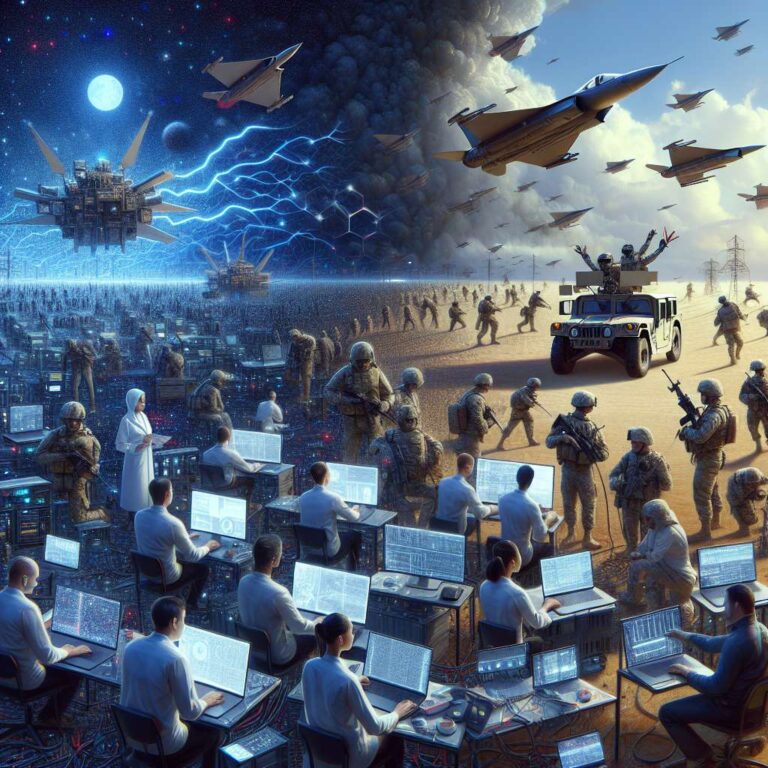
Artificial Intelligence is reshaping warfare, but durable military advantage is becoming harder to preserve. American firms lead in model development, semiconductor design, and private investment, yet those strengths do not guarantee exclusive battlefield benefits. In Artificial Intelligence, the time between a breakthrough and an adversary’s replication is compressed to months or even weeks, reducing the value of discovery alone. As core methods spread quickly through open publications, open-weight releases, and researcher networks, the decisive question becomes who can build on shared advances and field them fastest.
The comparison with nuclear technology highlights why this competition is different. Nuclear knowledge spread widely, but scarce materials and tightly controlled manufacturing limited who could build weapons. Artificial Intelligence depends on compute and talent rather than physically rare inputs, and those resources are commercially available and globally distributed. Research diffusion is accelerating through venues like arXiv, where submissions in artificial intelligence alone grew from roughly 12,500 papers in 2021 to nearly 45,000 in 2025. Open-weight models now lag state-of-the-art performance by just three months, and frontier capabilities become accessible on consumer-grade hardware within twelve. Algorithmic efficiency is improving at roughly three times per year, allowing advances to spread quickly across borders and institutions.
Recent examples show how rapidly implementation follows disclosure. When Meta’s LLaMA model leaked in March 2023, the open-source community created instruction-tuned, quantized, and multimodal variants within weeks. DeepSeek’s R1 release in January 2025 showed how Chinese developers could recombine techniques from Western research under compute constraints and still produce a model competitive with leading American systems. That pattern shifts the contest from exclusive invention to infrastructure and execution. America possesses over four thousand data centers to China’s roughly four hundred, and American Artificial Intelligence hyperscaler spending dwarfs analogous Chinese investment by a factor of five. But that edge is narrowing as export controls loosen and China benefits from an energy base whose installed generation capacity is more than double that of the United States, while adding new capacity fifteen times faster than America does.
Military use adds another challenge because many systems must run at the edge rather than in commercial cloud environments. Artificial Intelligence deployed on ships, aircraft, forward bases, or in communications-denied settings requires hardware and power profiles suited to local inference. Long integration cycles become a liability when models evolve so quickly. The Department of Defense’s directive to integrate commercial Artificial Intelligence models within thirty days of public release reflects the need to keep pace, but success depends on flexible compute, rapid engineering, and streamlined adoption.
Talent and institutional design are equally important. China now produces nearly twice as many science and engineering PhD graduates as the United States, and MacroPolo found that the share of top Artificial Intelligence researchers working at US institutions fell from 59 percent in 2019 to 42 percent in 2022, while China’s share rose from 11 percent to 28 percent. Within the US military, the harder problem is retaining personnel who can adapt general-purpose models to mission-specific use. Programs such as the Army’s Artificial Intelligence Integration Center and a formal Artificial Intelligence and machine learning officer career track aim to build that expertise, but promotion structures can still push technically trained officers out. In this environment, advantage depends less on owning breakthroughs than on sustaining tempo through edge compute, retained talent, and organizations that move faster from commercial innovation to operational capability.