
Micron 9650 PCIe Gen 6 data center SSD enters mass production

Micron’s 9650 NVMe SSD is the first PCIe Gen 6 data center drive to reach mass production, delivering major performance and efficiency gains over PCIe Gen 5 models. The drive targets high-throughput Artificial Intelligence training and inference workloads with support for both air and liquid cooling.

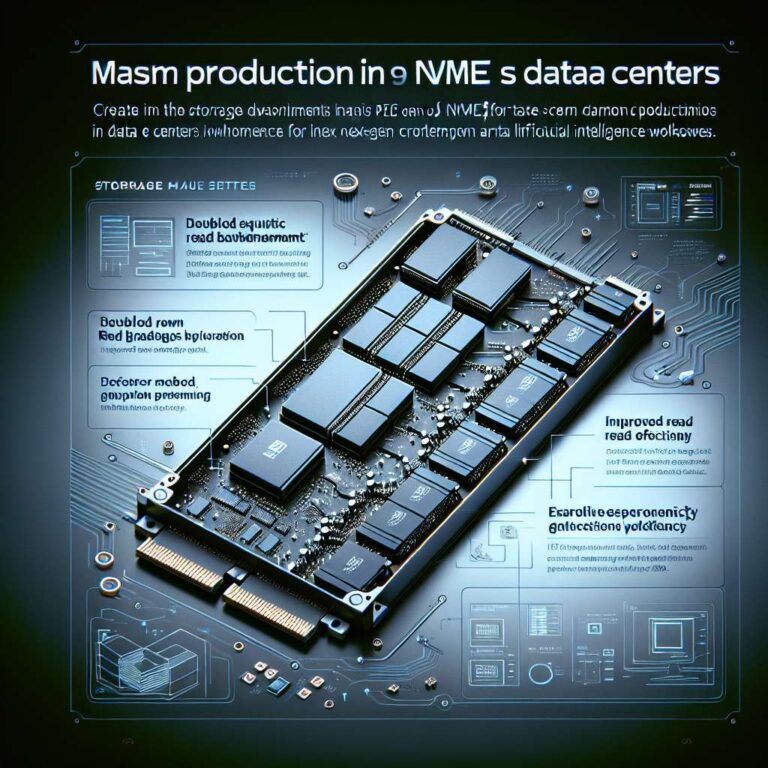
Micron’s 9650 NVMe SSD has entered mass production, becoming the first PCIe Gen 6 data center drive to reach this stage. The series was first unveiled in July 2025 and is built around Micron G9 TLC NAND, with a Micron designed SSD controller ASIC, DRAM, and Micron produced and validated firmware integrated to deliver a fully in-house storage platform. The product is aimed squarely at next generation data centers that require higher bandwidth and lower latency storage for demanding workloads.

The Micron 9650 delivers up to 28 GB/s in sequential reads, double that of PCIe Gen 5 drives, and its sequential write speed reaches 14 GB/s, while its random read performance hits 5.5 million IOPS and its random write achieves 900,000 IOPS. These numbers show 100%, 40%, 67%, and 22% gains over Gen 5 while holding a clear focus on balanced throughput and responsiveness. At a 25-watt power state, the drive offers double the performance of PCIe Gen 5 options, enabling significantly higher performance per rack within existing power envelopes. It has a sequential read efficiency of 1,120 MB/s per watt (2× better than Gen 5), and its sequential write efficiency is 560 MB/s per watt (1.4 times better). The random read efficiency stands at 220 KIOPS per watt (1.7 times higher) and random write at 36 KIOPS per watt (1.2 times improved), underscoring the platform’s gains in both raw speed and energy efficiency.

The Micron 9650 supports both air-cooled and liquid-cooled configurations to handle higher performance densities in modern data centers, with E1.S and E3.S form factors available and E1.S offered for liquid cooling. Micron conducted 18 months of interoperability testing across the PCIe Gen 6 ecosystem, including validation with high-port switches, retimers, and demonstrations at industry events, to ensure readiness for deployment. The drive is now being qualified by OEM and Artificial Intelligence data center customers for use in Artificial Intelligence training and inference workloads that demand high-throughput data access for large language models and retrieval-augmented generation pipelines, positioning it as a foundational storage option for next generation Artificial Intelligence infrastructure.
65

Impact Score

HMRC signs £175m Quantexa deal for fraud detection

HM Revenue and Customs has signed a £175 million, 10-year agreement with Quantexa to unify fragmented data and strengthen fraud detection. The deployment is designed to automate routine work while keeping decisions transparent, auditable and subject to human approval.

Us supercomputers test new Artificial Intelligence chip suppliers

Sandia National Laboratories is evaluating chips from Israeli startup NextSilicon as major chipmakers shift their roadmaps toward Artificial Intelligence. The move reflects growing concern that mainstream processors are deprioritizing the scientific computing features government labs still need.

EU Artificial Intelligence Act amendments delay some deadlines and add new bans

A provisional Digital Omnibus on Artificial Intelligence would push back several EU Artificial Intelligence Act deadlines, refine how the law interacts with sector rules, and introduce new prohibited practices. The package also expands limited bias-testing allowances and strengthens centralized oversight for some high-impact systems.

Qwen 3.5 raises concerns about censorship embedded in model weights

A technical analysis of Alibaba Cloud’s Qwen 3.5 points to political censorship circuits embedded directly in the model’s learned weights. The findings highlight operational, compliance, and product risks for startups building on third-party Artificial Intelligence models.

Laptop prices rise as memory shortages hit PCs

Laptop prices are climbing as memory makers redirect production toward data center demand driven by Artificial Intelligence. The squeeze is spreading beyond RAM to graphics memory and SSDs, raising costs across the PC market.

Contact Us

Got questions? Use the form to contact us.

Contact Form

Clicking next sends a verification code to your email. After verifying, you can enter your message.