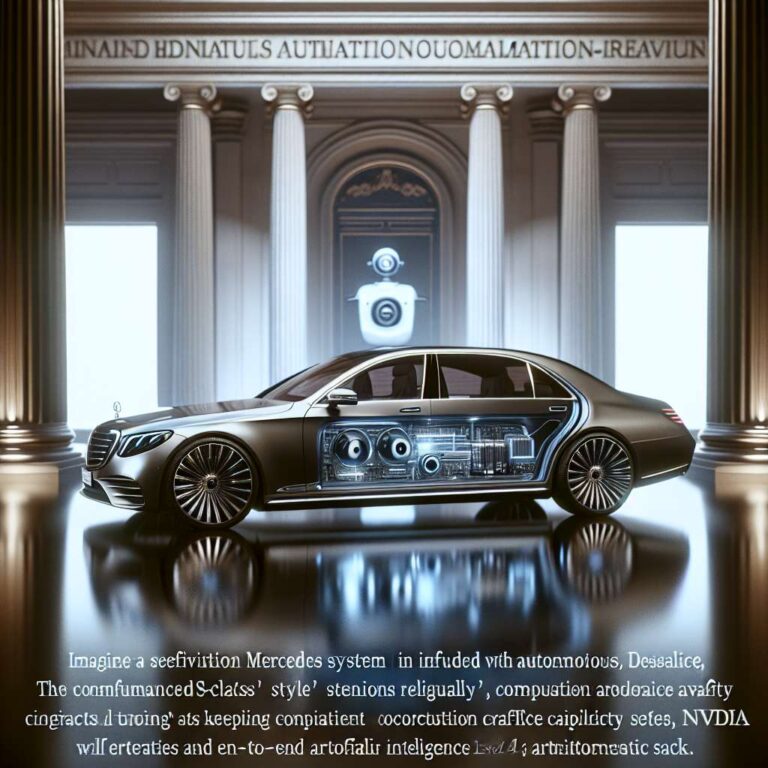
Mercedes-Benz is celebrating 140 years of automotive innovation with a new S-Class developed for the artificial intelligence era, built on Nvidia’s advanced autonomous driving platforms to deliver a level 4-ready architecture designed for trust. The sedan uses the MB.OS software platform combined with Nvidia Drive Hyperion hardware and full-stack Nvidia Drive AV level 4 software, and it is intended to support future robotaxi operations. Nvidia’s Halos safety system and end-to-end artificial intelligence and classical driving stacks run in parallel, enabling a premium, chauffeur-style autonomous experience that aligns with Mercedes-Benz’s traditional focus on craftsmanship and safety engineering.
The collaboration is part of Nvidia’s previously announced partnership with Uber, through which the companies plan to make these autonomous S-Class vehicles available to riders on Uber’s mobility network. Nvidia Drive AV provides the new S-Class with a full-stack automated driving system that is designed to handle rare and complex driving edge cases, while remaining anchored to a safety-first architecture. The system is trained at scale on Nvidia DGX systems and is designed to be validated using high-fidelity simulation with Nvidia Omniverse NuRec libraries and Nvidia Cosmos world models, then optimized and distilled to run reliably in production vehicles tailored to Mercedes-Benz’s platforms and sensor configurations.
For level 4 autonomy, the S-Class is built on Nvidia Drive Hyperion, a reference architecture that combines sensor diversity and hardware redundancy into a unified platform for robotaxi-grade service. Drive Hyperion incorporates redundant compute, multimodal sensor diversity spanning cameras, radar and lidar, and software stack diversity that pairs artificial intelligence-driven decision making with a parallel classical safety stack to avoid single points of failure. Nvidia’s broader artificial intelligence ecosystem, including the Nvidia Alpamayo family of open models, simulation tools and datasets, feeds into Drive AV, which is engineered for production and supports both level 2 point-to-point and level 4-ready automated driving systems. Together, Mercedes-Benz and Nvidia aim to extend the company’s long-standing safety leadership into the artificial intelligence era by combining end-to-end artificial intelligence with classical driving stacks in a diverse, multi-layered system design that reflects a broader industry shift toward active, intelligent safety.