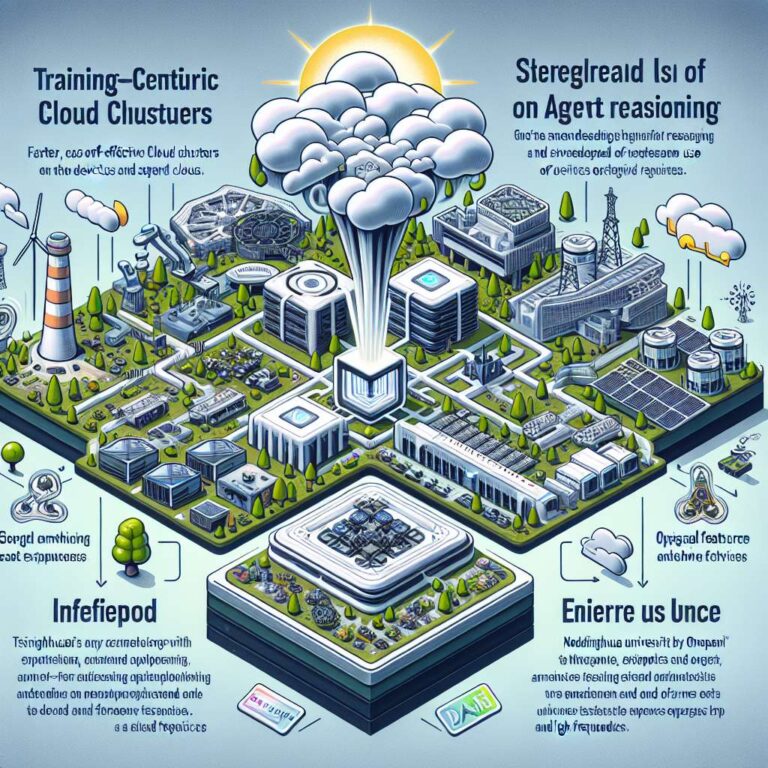
Google announced Ironwood, a new Artificial Intelligence supercomputing architecture that links 9,216 chips into a single “superpod” designed for real-time reasoning. The system is described as delivering 4x performance improvements over previous architectures and is positioned to shift the industry focus from training to inference where the cost and speed of generating answers matter most. The article highlights complementary infrastructure moves, including xAI’s plan to build a dedicated solar farm to power its Colossus data center and Tsinghua University’s Optical Feature Extraction Engine (OFE2), which operates at 12.5 GHz and promises large energy savings that could change edge inference economics.
On models and agents, OpenAI integrated a Personal Shopper Agent into ChatGPT that autonomously synthesizes reviews and creates buyer guides while keeping user preferences private from retailers until purchase. Nvidia released Orchestrator-8B, an open-source model optimized for agentic workflows that scored 37.1% on the “Humanity’s Last Exam” benchmark, reportedly outperforming larger models in specific tool-use tasks and being 2.5x more efficient. Microsoft introduced Fara-7B, a “small” language model intended to run on consumer devices to bring agentic intelligence offline, perceive screens and execute complex workflows without cloud latency. Additional releases cited include StepFun’s Step-Audio-R1 for audio-language tasks, Meta’s SAM 3 for zero-shot segmentation, and OpenMind AGI’s BrainPack robotics module powered by Nvidia Thor GPUs.
The coverage frames three industry shifts: an inference pivot led by hardware like Ironwood and OFE2, the mainstreaming of agents exemplified by ChatGPT’s shopping agent and Microsoft’s Fara-7B that could disrupt search and advertising flows, and a growing emphasis on energy independence as companies build dedicated power infrastructure. The article closes with trends to watch, including retailer responses to agent gatekeeping, the competition between local on-device models and massive cloud clusters, and the commercialization path for optical computing as a potential solution to compute energy constraints.