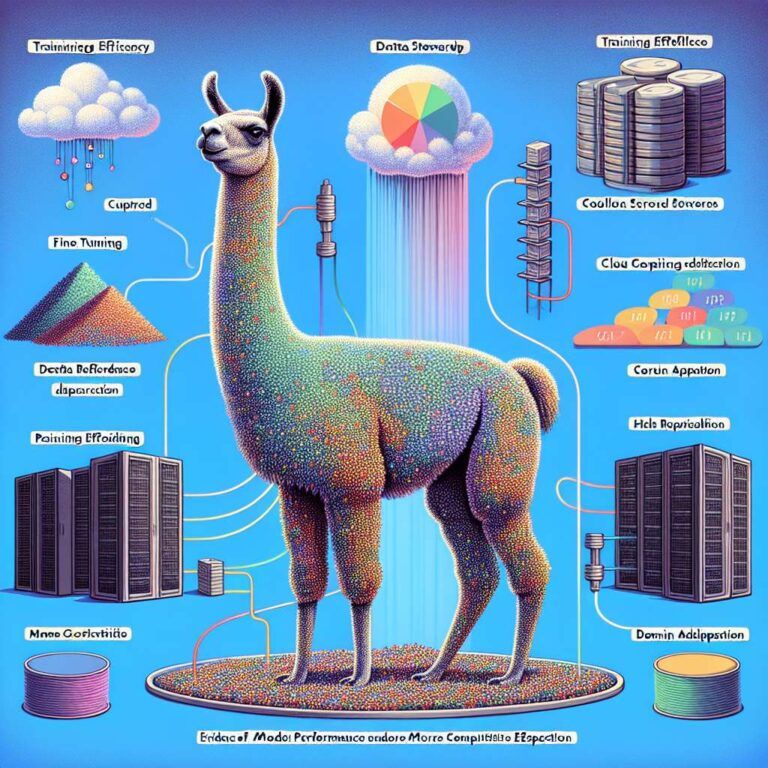
Llama is introduced as a family of foundation language models designed to be both open and efficient, with parameter scales ranging from 7B to 65B. The models are trained on trillions of tokens, with a focus on demonstrating that competitive performance can be achieved without relying on proprietary or otherwise inaccessible datasets. The work positions Llama as a reference point for the research community, highlighting that careful data curation and scaling laws can close much of the gap with the largest commercial systems while remaining within more modest compute budgets.
Within the model suite, the 13B parameter variant plays a central role by showing that a comparatively smaller model can outperform much larger predecessors when training data and optimization are handled effectively. In particular, LLaMA-13B outperforms GPT-3 (175B) on most benchmarks, underscoring the efficiency gains from the training setup and dataset choices. At the high end, LLaMA-65B is competitive with the best models, Chinchilla-70B and PaLM-540B, suggesting that the approach scales favorably and that open, non-proprietary data can support state-of-the-art performance across a range of language understanding and generation tasks.
A central goal of the project is to support broad, reproducible research on large language models by making the full set of models available to the research community. The release covers all model sizes in the Llama family, enabling investigations into topics such as scaling behavior, fine tuning, alignment, and domain adaptation without the usual barriers around closed weights or opaque training corpora. This open-access stance is framed as part of a wider effort to foster progress in natural language processing by lowering the entry cost for experimentation with high-capacity foundation models and encouraging comparative studies that can drive further algorithmic and data efficiency advances.