
Lexar tests SSD offloading for local AI models

Lexar is developing an AI-focused SSD approach designed to cut DRAM demand when running large language models on consumer PCs. Internal tests show the company’s storage offloading can load models that traditional local frameworks struggle to run with limited memory.

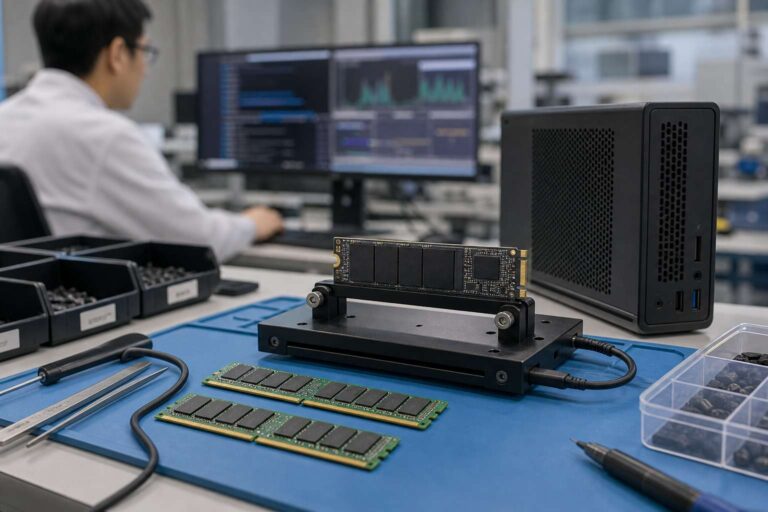
Lexar is developing storage technology aimed at shifting some local AI workload demands from DRAM to NAND Flash. Chief Technical Officer Daniel Guo said DRAM is about six times more expensive to manufacture than NAND Flash, creating an opportunity for AI SSDs to lower the memory requirements of running large language models on local hardware. The Lexar AI Storage Core SSD is intended to support local AI deployments by offloading models to storage, reducing memory footprint by at least 40%.

In internal testing, Lexar ran the Qwen 3.5 122B AI model on a local PC. The company said its Lexar AI suite and AI Storage Core SSD reduced the DRAM requirement from 128 GB to 32 GB for a related configuration, running a model with 35 billion parameters at 15.6 tokens per second versus 5.2 tokens per second using traditional frameworks. When loading the 122B model on 32 GB of DRAM, Llama.cpp failed and crashed, while Lexar’s SSD offloading reached about 4.4 tokens per second.
55

Impact Score

NVIDIA Blackwell leads MLPerf Training 6.0

NVIDIA’s latest MLPerf Training 6.0 results put Blackwell across every benchmark in the suite, including new MoE workloads. Partner systems from Microsoft Azure and CoreWeave highlighted large-cluster runs on Llama 3.1 405B and DeepSeek-V3 671B.

HPE and NVIDIA expand AI Factory for agentic systems

HPE and NVIDIA are adding agent tooling, confidential computing and updated accelerated systems across the HPE AI Factory portfolio. The expansion targets production deployments that need governance, secure data handling and integrated networking.

Coherent expands Texas optics plant for AI data centers

Coherent’s Sherman expansion will increase production of indium phosphide wafers used in lasers, transceivers and optical modules for large AI data centers. NVIDIA CEO Jensen Huang framed the site as part of a broader push to rebuild U.S. semiconductor manufacturing.

Contact Us

Got questions? Use the form to contact us.

Contact Form

Clicking next sends a verification code to your email. After verifying, you can enter your message.