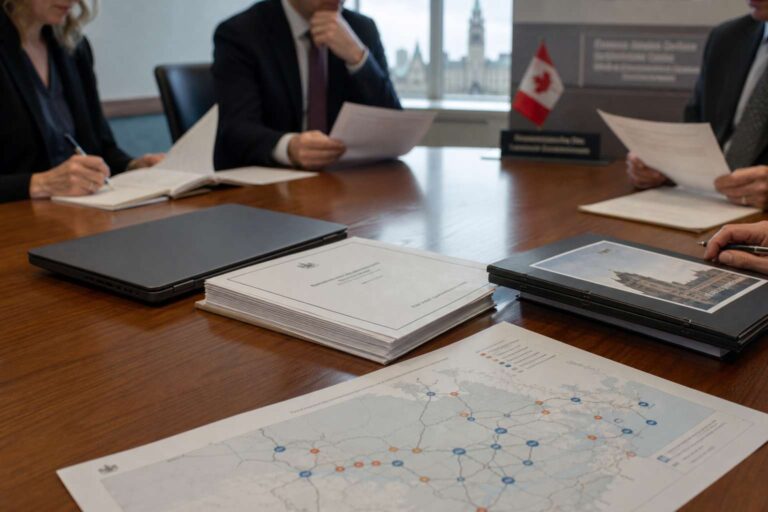
Canadian Prime Minister Mark Carney used the US export control on Anthropic’s Claude Fable 5 and Mythos 5 to make a pointed argument on June 14, 2026: Canada must build its own Artificial Intelligence infrastructure rather than depend on US-controlled platforms. Carney framed the Anthropic ban not as an exception, but as a preview of how US national security authorities may treat Artificial Intelligence technology going forward. The move came days after Canada launched its “AI for All” national strategy, which committed to building a public Artificial Intelligence supercomputer and Canadian-owned cloud infrastructure.
Canada’s exposure is unusually sharp because its research base is strong while its deployment and compute capacity lag. The country has world-class Artificial Intelligence research talent anchored in Toronto, Montreal, and Vancouver, including institutions that helped train researchers now working at Anthropic, OpenAI, and Google DeepMind. But Canada’s Artificial Intelligence adoption rate of 12% is among the lowest in the G7, and its Artificial Intelligence compute infrastructure is negligible compared to US hyperscalers. Aaron Shull of the Centre for International Governance and Innovation said Canada hosts world-class talent and three national institutes, yet attracts only a small fraction of global Artificial Intelligence investment and trails on infrastructure.
The export control also highlighted that alliance status does not guarantee access. Canada is part of the Five Eyes intelligence sharing agreement, a CUSMA partner, and a member of major Western security alliances, but the US order appeared to make no exception for allied nations. Shull summarized the issue bluntly: “To an export control regime, a Canadian is a foreign national, full stop.” That distinction has become central to Ottawa’s case for sovereign Artificial Intelligence systems.
Middle powers including Canada, the UK, the EU, Japan, and India are accelerating plans for sovereign Artificial Intelligence capabilities in direct response. Carney has been building a coalition of countries outside the US and China to develop shared infrastructure independent of both superpowers. Bloomberg reported that the Anthropic ban has accelerated those conversations significantly, with Canada, the EU, Japan, and India all moving faster on sovereign Artificial Intelligence commitments than they were before June 13.
Businesses are being pushed to treat geopolitical access risk as a core vendor issue. Frontier Artificial Intelligence laboratories have become strategic chokepoints, and a provider can be compliant, financially healthy, and technically strong while still becoming unavailable through government export controls. Companies with global operations and non-American Artificial Intelligence users are being urged to review platform dependencies, identify non-US alternatives or fallback models, and prepare continuity plans if access is suspended without warning.