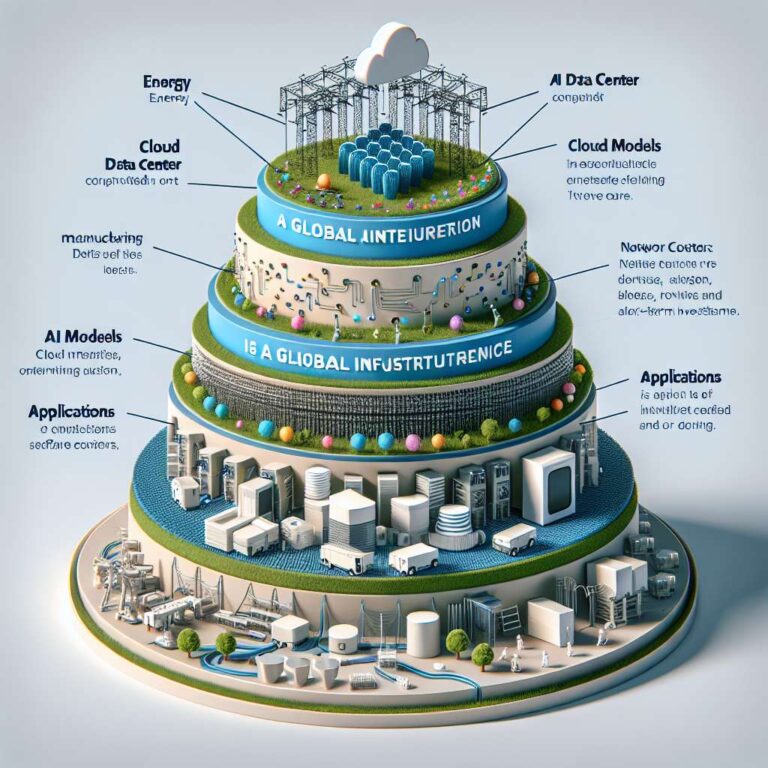
At the World Economic Forum annual meeting in Davos, Switzerland, NVIDIA founder and CEO Jensen Huang argued that Artificial Intelligence now underpins what he called “the largest infrastructure buildout in human history,” with implications that reach from skilled trades to startups. In a mainstage conversation with BlackRock chair and CEO Larry Fink, Huang said Artificial Intelligence should be seen not as a single technology but as “a five-layer cake” consisting of energy, chips and computing infrastructure, cloud data centers, Artificial Intelligence models, and an application layer on top. Because every layer of this stack must be built and run, he described a broad-based wave of job creation, from energy and construction to advanced manufacturing, cloud operations, and software development.
Huang emphasized that the greatest economic value will emerge at the application layer, where companies integrate Artificial Intelligence into sectors such as financial services, healthcare, manufacturing, and robotics. He pointed to venture capital as a leading indicator of this shift, saying 2025 was one of the largest years for VC funding on record, with most of that capital directed to “AI-native companies” in areas where “for the first time, the models are good enough to build on top of.” He linked this investment directly to jobs, spotlighting strong demand for plumbers, electricians, construction workers, steelworkers, network technicians, and teams that install and operate advanced equipment to support new data centers and cloud infrastructure.
On the workforce impact, Huang argued that Artificial Intelligence is changing tasks rather than eliminating the underlying purpose of jobs, using radiology and nursing as examples. He said the U.S. faces a shortage of roughly 5 million nurses, in part because nurses spend nearly half their time on charting and documentation, and he said that now they can use Artificial Intelligence to do the charting and the transcription of patient visits, which he expects to boost productivity and hiring. Huang framed Artificial Intelligence as critical national infrastructure and urged countries to build systems rooted in local language and culture, stating that “you should have AI as part of your infrastructure.” He noted that “AI is super easy to use – it’s the easiest software to use in history,” and that in just two to three years, Artificial Intelligence tools have reached nearly a billion people, making Artificial Intelligence literacy a core skill akin to leadership. Looking ahead, he said Artificial Intelligence can help close technology divides, particularly if regions like Europe pair their industrial strengths with robotics and “physical AI,” and he agreed with Fink that the key question is not whether there is an Artificial Intelligence bubble but whether the world is investing enough to build all layers of this emerging infrastructure.