
Intel W890 workstation platform details leak ahead of Granite Rapids-WS launch

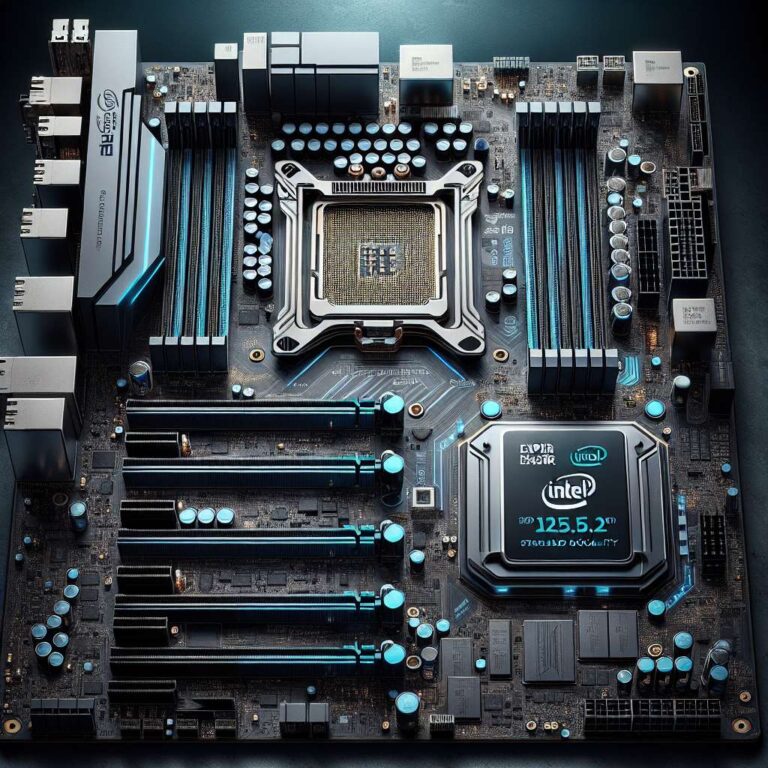
Intel's W890 workstation platform has leaked, showing a new Socket E2 design and support for high‑TDP 'Granite Rapids-WS' workstation Xeon processors. The platform splits into Expert and Mainstream tiers with differing PCIe lane counts and expands memory and management features.

Leaked details of Intel’s W890 workstation platform describe a new Socket E2 layout with 4,710 LGA pins and support for processors with thermal design power ratings up to 350 watts. Intel is reported to be positioning the platform as the foundation for upcoming ‘Granite Rapids-WS’ high-end desktop workstation Xeon processors, with an XCC-based part cited that offers 86 cores and 172 threads, single-core boost speeds near 4.8 GHz, and 336 MB of L3 cache.

The platform adopts a two-tier approach. Expert-class implementations unlock a total of 112 PCIe lanes, split into 96 PCIe 5.0 lanes plus 16 PCIe 4.0 lanes, while the Mainstream tier provides 80 PCIe 5.0 lanes. These lane counts are aimed at high-bandwidth workstation configurations and multi-device expansion common in HEDT setups.

Memory support is a notable evolution for the W890. The chipset accepts both standard DDR5 DIMMs and registered DDR5 modules, with RDIMMs validated for speeds up to 5,200 MT/s. In a quad-channel arrangement with two DIMMs per channel, a single processor socket can address up to 2 TB of memory. Connectivity options listed in the leak include a 2.5 Gigabit Ethernet controller, multiple USB 3.2 and USB 2.0 ports, several SATA III interfaces, and dual SlimSAS connectors that each provide PCIe 4.0 x4 bandwidth.

Server-grade management and power delivery features are also included. The platform reportedly incorporates an ASPEED AST2600 baseboard management controller and a Nuvoton system supervisor for hardware management. Power provisions call for a standard 24-pin ATX connector plus support for up to four additional 8-pin CPU power headers to meet the demands of high-TDP processors and robust peripheral configurations.
55

Impact Score

Who decides how America uses Artificial Intelligence in war

Stanford experts are divided over how the United States should govern Artificial Intelligence in defense, surveillance, and warfare. Their views converge on one point: decisions with such high stakes cannot be left to companies alone.

GPUBreach bypasses IOMMU on GDDR6-based NVIDIA GPUs

Researchers from the University of Toronto describe GPUBreach, a rowhammer attack against GDDR6-based NVIDIA GPUs that can bypass IOMMU protections. The technique enables CPU-side privilege escalation by abusing trusted GPU driver behavior on the host system.

Google Vids opens free video generation to all Google users

Google has made Google Vids available to anyone with a Google account, adding free access to video generation with its latest models. The move expands Google’s end-to-end video workflow and increases pressure on rivals that charge for similar tools.

Court warns against chatbot legal advice in Heppner case

A federal court found that chats with a publicly available generative Artificial Intelligence tool were not protected by attorney-client privilege or the work-product doctrine. The ruling highlights litigation risks when executives or employees use chatbots for legal guidance without lawyer supervision.

Contact Us

Got questions? Use the form to contact us.

Contact Form

Clicking next sends a verification code to your email. After verifying, you can enter your message.