
Intel debuts glass core substrate for multi chip accelerators

Intel has introduced a 10-2-10 glass core substrate with EMIB multi chip connectivity, targeting next generation high performance Artificial Intelligence and HPC accelerators with larger silicon area and finer signal routing.

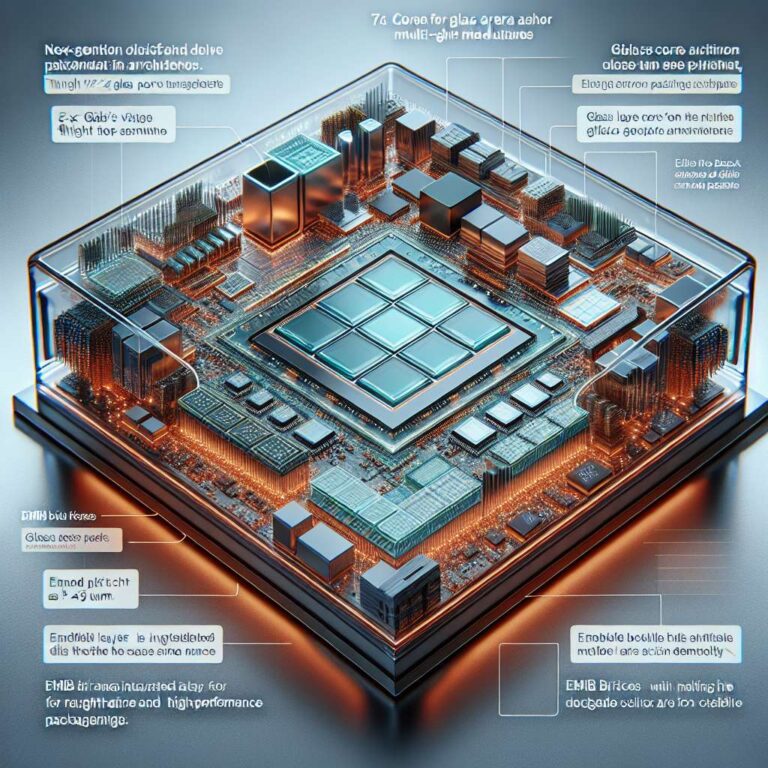
At NEPCON Japan 2026, Intel showcased a new glass substrate technology aimed at powering the next generation of advanced Artificial Intelligence and high performance computing accelerators. According to SemiVision Taiwan, Intel has created a high performance core glass substrate measuring 78×77 mm for the entire package. This substrate can accommodate approximately twice the reticle size with silicon, equating to about 1,716 mm² (2×858 mm²) of silicon area for logic and memory.

Intel describes this as the first 10-2-10-thick glass core substrate that integrates its EMIB multi chip module technology. The 10-2-10 designation refers to 10 redistribution layer build up layers on the top of the substrate, a 2 layer glass core, and 10 build up layers on the bottom side. The 10 redistribution layer (RDL) build up layers on the top of the substrate are used to redistribute signals from the die, and these layers handle fine pitch routing, with Intel dedicating as many as 10 layers for this purpose.

The core of the glass substrate consists of two layers and is made of 800 μm (or 0.8 mm) class material, which may include embedded metal layers for through-glass-vias or power and ground planes. The final ’10’ number denotes the number of build up layers on the bottom side, mirroring the top for symmetric routing to connect to the motherboard or PCB, and this bottom stack helps declutter the dense wiring from the silicon die so it can interface more cleanly with a standard board. Intel’s 10-2-10 glass core substrate is also equipped with some of the finest bump pitches in the market, with 45 μm (only 0.045 mm) bump pitch. Finally, Intel embeds two EMIB bridges for multi-chip-module packaging so you can manufacture several smaller dies and interconnect them via EMIB bridge, present on the glass core.
55

Impact Score

Indiana launches Artificial Intelligence business portal

Indiana is rolling out IN AI, a statewide portal meant to help employers adopt Artificial Intelligence with practical guidance, workshops and peer support. State leaders and business groups are positioning the effort as a way to raise productivity, wages and job growth while keeping workers at the center.

Goodfire launches model debugging tool for large language models

Goodfire has introduced Silico, a mechanistic interpretability platform designed to let developers inspect and adjust model behavior during development. The company is positioning it as a way to give smaller teams deeper control over open-source models and more trustworthy outputs.

Nvidia launches nemotron 3 nano omni for enterprise agents

Nvidia has introduced Nemotron 3 Nano Omni, a multimodal open model designed to support enterprise agents that reason across vision, speech and language. The launch extends Nvidia’s push beyond hardware into models and services while targeting more efficient agentic workflows.

Intel 18A-P node improves performance and efficiency

Intel plans to present new results for its 18A-P process at the VLSI 2026 Symposium, highlighting gains in performance, power efficiency, and manufacturing predictability. The updated node is positioned as a stronger option for customers seeking 18A density with better operating characteristics.

EA CEO defends broader Artificial Intelligence use in game development

EA CEO Andrew Wilson defended the company’s internal use of Artificial Intelligence after employee claims that the tools were slowing work rather than helping. He framed the technology as an aid for repetitive quality assurance tasks, even as concerns persist over its broader impact on development.

Contact Us

Got questions? Use the form to contact us.

Contact Form

Clicking next sends a verification code to your email. After verifying, you can enter your message.