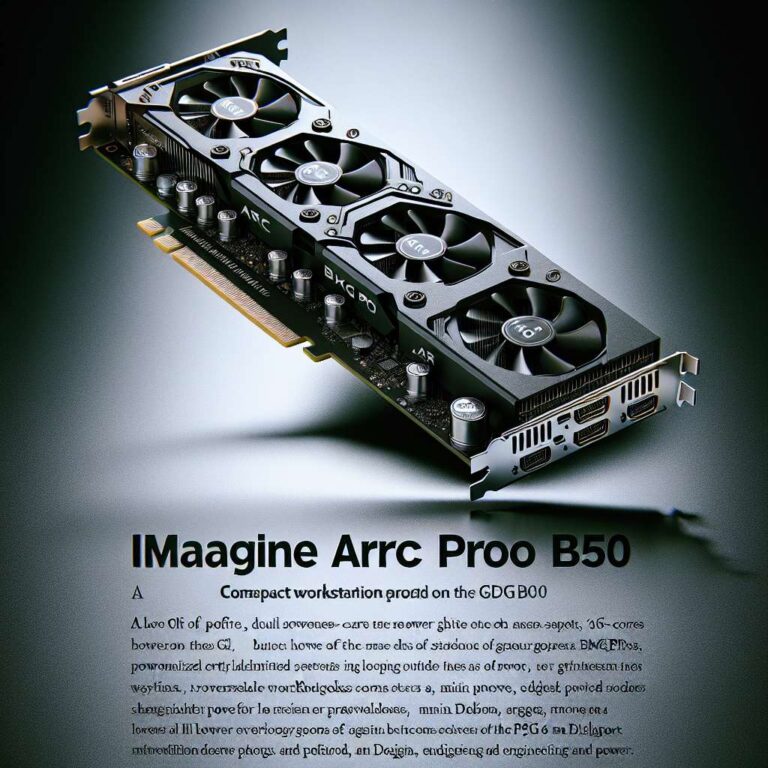
Intel has shipped the Arc ´Battlemage´ Pro B50 workstation GPU to reviewers, showcasing the capabilities of the BMG-G21 silicon in a compact, small-form-factor design. The card includes 16 Xe2 cores and 16 GB of GDDR6 memory clocked at 14 Gbps on a 128-bit bus, yielding roughly 224 GB per second of memory bandwidth. The board is a dual-slot, low-profile model that uses only the PCIe slot for power, with a total board power of 70 W and no external power connectors. Signal lanes run at PCIe Gen 5 using eight lanes.
Intel positions the Arc Pro series for a range of GPU-accelerated workflows, explicitly naming Artificial Intelligence, design, engineering, architecture and manufacturing applications. The company pairs the hardware with workstation-focused, validated graphics drivers intended to provide robust, reliable performance in professional environments. Intel asserts the B50 delivers 170 TOPS of INT8 compute and describes it as suitable for local Artificial Intelligence work. The card offers four mini DisplayPort outputs and will be sold either as a standalone package or integrated into OEM systems. Pricing is not provided in the article and is listed as not stated.
The shipment to reviewers is framed as a demonstration of what the BMG-G21 silicon can deliver in a tiny chassis, highlighting trade-offs inherent to low-power, small-form-factor cards. While memory bandwidth, modest core count and 70 W power limit absolute throughput compared with larger workstation cards, Intel argues these characteristics are balanced to keep the 16 Xe2 cores fed and to support local inference and professional workloads in space-constrained systems. The article references Intel´s official performance figures but does not include specific benchmark numbers in the text. Availability timing beyond reviewer shipments is not stated.