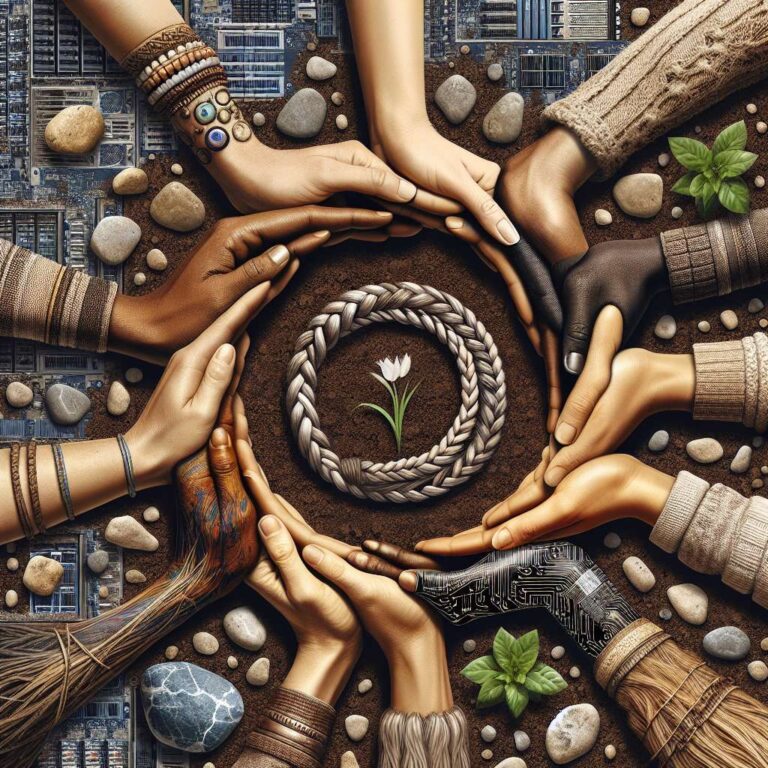
Many Native languages do not have a word for art because art is not conceived as objecthood but as action, responsibility and ceremony. The Lakota terms wówačhiŋtȟaŋka and wóčhekiye point to reflection and offering rather than to static artifacts. That relational framing sits uneasily with a tech culture built on extraction, opaque consent and large centralized models that treat data as raw material. The article argues that Native modes of making demand a different ontology of intelligence, one that privileges reciprocity, use and accountability.
A new cohort of Native artists is putting those principles into practice by building systems that make relationship a precondition for learning. Suzanne Kite models a Lakota idea of data sovereignty through kinetic, consent-driven installations. Her work translates bodily movement into machine behavior via embedded sensors in a braided hair sculpture and arranged stones that reference Lakota star maps. Kite describes the process as intimate and transparent: ´It´s my data. It´s my training set. I know exactly what I did to train it.´ Her practice rejects spectacle for layered complexity that binds technique to ritual and community.
Other practitioners widen the critique. Raven Chacon uses sound and site specificity to expose how sensor networks record presence and absence, as in Voiceless Mass, which generates frequencies tailored to a cathedral´s acoustics and records performances only with clear consent. Nicholas Galanin stages mechanical drumming and monumental sculpture to ask what happens when cultural forms are automated without the consenting body. His mechanical box drum, reinterpreted in cherrywood and struck by a robotic arm at a heartbeat tempo, makes the tension between ancestral memory and mechanized repetition audible. His bronze work built from faux totem blocks calls attention to the ways settler systems have repurposed Indigenous information systems.
Taken together the projects refract a larger claim: Indigenous technologies have always been technological, embedded in land, lifeways and governance. These artists are not asking to be included in existing systems. They are proposing alternatives where the default is refusal, where intelligence emerges through exchange, and where sovereignty and reciprocity structure design. The result is a palpable challenge to assumptions about automation, authorship and who gets to define what counts as intelligence.