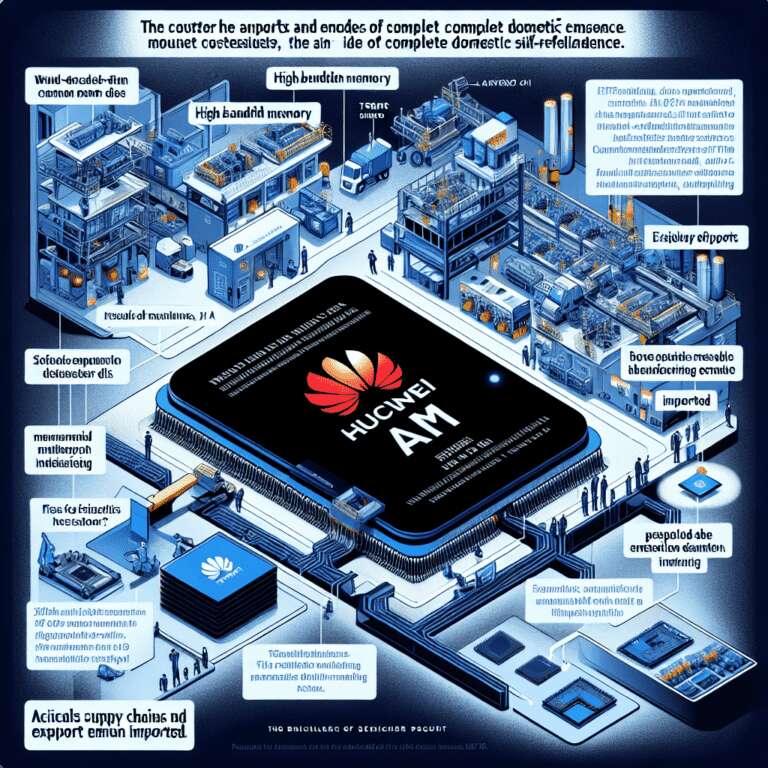
Recent analysis indicates that Huawei´s Ascend 910C Artificial Intelligence accelerator chips are not fully domestically manufactured as often claimed. While the design and assembly occur within China, the chips rely significantly on foreign technologies and suppliers for their critical components and fabrication processes. This includes high-bandwidth memory (HBM) from Samsung in South Korea, wafer production from Taiwan Semiconductor Manufacturing Company (TSMC), and fabrication equipment sourced from the United States, the Netherlands, and Japan.
SemiAnalysis reports that despite advances by SMIC—China´s leading semiconductor foundry—on its 7nm manufacturing processes, the vast majority of Ascend 910B and 910C chips are made using TSMC´s more mature 7nm node. Investigators, including the US government and TechInsights, have examined multiple samples of Huawei´s Artificial Intelligence chips, confirming that every one contained TSMC-manufactured dies. These findings suggest that Huawei has depended on non-Chinese supply chains and has maneuvered around export controls by acquiring wafers through intermediaries like Sophgo.
The report also highlights Huawei´s strategy to bypass US-imposed sanctions restricting access to advanced semiconductor manufacturing technology. While SMIC may be progressing in its efforts to mature Chinese alternatives, Huawei´s current Artificial Intelligence chip production still heavily leans on established foreign sources to achieve competitive performance. The trend is contrasted with other Chinese firms such as Xiaomi, which maintains access to TSMC for consumer-grade chips, though not at the scale required for enterprise-grade Artificial Intelligence hardware.