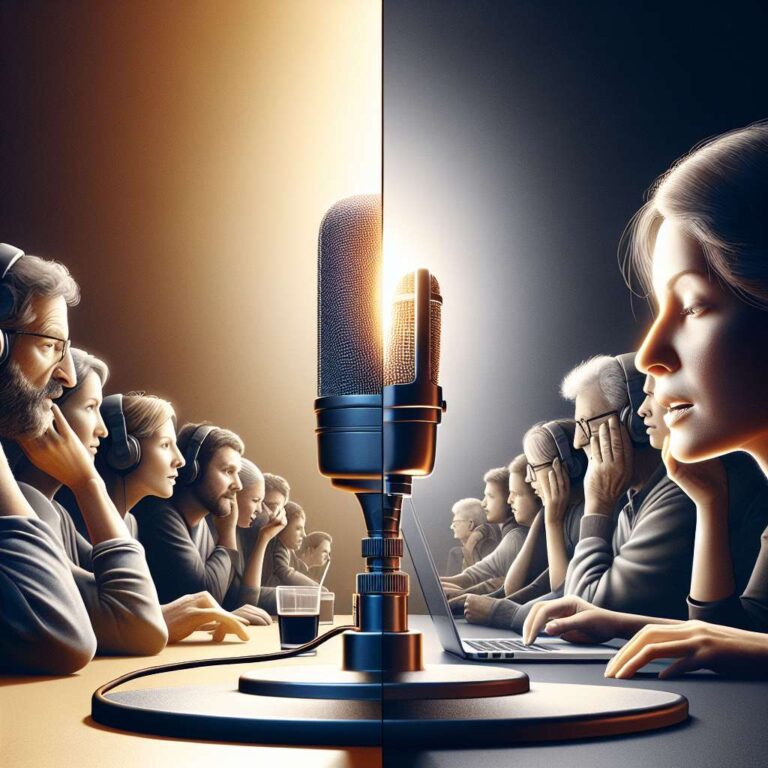
The article explores how sound has become a defining element of communication in a world where business, education, and social interaction are increasingly mediated by screens. While people obsess over lighting, camera angles, and virtual backgrounds, audio experts such as Shure executive Erik Vaveris and Yale University cognitive scientist Brian Scholl argue that how we sound strongly influences perceptions of intelligence, credibility, and authority. Scholl’s research shows that poor audio quality can make speakers seem less persuasive, less hireable, and less trustworthy, even when listeners can clearly understand the words being spoken. In virtual environments, this subtle bias can shape key outcomes in hiring, collaboration, and personal interactions.
Vaveris describes the pandemic as a watershed moment for audio technology, when classrooms, boardrooms, and events moved online in 2020 and forced organizations to confront the importance of sound quality. Audio processing development accelerated across the AV industry, with advanced noise suppression, echo cancellation, and Artificial Intelligence driven algorithms becoming standard. Today, machine-learning-trained digital signal processing routinely strips out keyboard clicks, chip eating, room reverberation, and other distractions, while also isolating the desired voice signal, sometimes using features like voice print matching. This clarity benefits not only human participants but also emerging Artificial Intelligence meeting assistants that need clean, accurate audio to transcribe, summarize, attribute speech to different speakers, and eventually interpret sentiment and emotion.
Scholl’s experiments provide concrete evidence of audio’s impact on judgment. In controlled studies, participants heard identical speech clips that differed only in recording quality: one set captured with a clear, high quality microphone, the other processed to sound tinny and disfluent but still fully intelligible. Across hiring scenarios, dating judgments, and an insurance-style credibility test after a car accident, speakers with lower quality audio were judged to be about 8% less hirable, about 8% less intelligent, and their stories were about 8% less credible. Scholl notes that people know intuitively that incomprehensible audio is a problem but often assume that “as long as you can make out the words” it is good enough, and his research shows this assumption is wrong. Audio professionals see this data as validation of long held beliefs about the value of good sound.
The conversation also highlights broader workplace and cultural shifts triggered by remote and hybrid work. Both Vaveris and Scholl say virtual platforms created unexpected positives, from easier access to global experts in university seminars to more equitable participation for colleagues who are not in the main room or who speak in a non native language. Companies now invest heavily in collaboration tools that are simpler to deploy and manage at scale, using cloud and internet of things technologies so IT teams can support classrooms and conference rooms worldwide. Standardized interfaces across services like Zoom, Microsoft Teams, and Google’s platforms have reduced the friction and time once wasted just getting meetings to start.
In parallel, the democratization of production tools is transforming marketing and internal communication. High quality microphones with built in signal processing and straightforward USB connectivity let executives, influencers, and employees record broadcast grade content from their desks without large crews or studios. Vaveris notes that not every campaign hinges on high production commercials anymore; creator driven videos, podcasts, and social clips can reach audiences effectively as long as the audio crosses a certain quality threshold. This shift also extends to internal training and leadership messages, where senior leaders routinely self produce videos for staff, relying on modern audio gear to maintain clarity and presence.
Looking ahead, both guests see an expanding role for Artificial Intelligence and audio innovation. Vaveris points to real time captioning, language translation that maintains a speaker’s own voice, and increasingly invisible audio tools that recede into the background while amplifying human connection. He envisions near term scenarios where participants can hear each other in their native languages, breaking down barriers that once limited global collaboration. Scholl, from a research perspective, anticipates a “Wild West” of audio filtering analogous to visual filters on photos, where subtle tweaks to bass, treble, and other dimensions of the sound signal could systematically influence how friendly, trustworthy, or authoritative someone seems, often without listeners realizing any manipulation has occurred. Both agree that the ultimate goal is seamless communication where technology disappears, but they caution that the growing power to shape perception through sound will carry both positive and problematic implications.
Overall, the discussion underscores that in a screen mediated world, audio is no longer a secondary technical detail but a central human factor. Clear, well engineered sound improves comprehension, reduces fatigue, and quietly boosts the impact of messages in meetings, classes, and media. As Artificial Intelligence and machine learning expand what is possible in noise reduction, signal isolation, analytics, and personalization, sound may prove to be one of the most powerful connectors available to organizations seeking trust, inclusion, and effectiveness in virtual spaces.