Artificial intelligence agents are rapidly moving from narrow roles like coding assistants and customer service chatbots into the operational core of businesses, where they can independently manage processes across lead generation, supply chain optimization, customer support, and financial reconciliation. The article argues that the shift to an agent-driven enterprise is inevitable because the economic upside is too large to ignore, and it notes that a mid-sized organization could easily run 4,000 agents, each making decisions that influence revenue, compliance, and customer experience. Yet most companies and their infrastructures are not ready for this transition, and early adopters are discovering how difficult it is to scale artificial intelligence initiatives reliably.
The author highlights a widening reliability gap between companies that see real returns from artificial intelligence and those that do not. Citing Boston Consulting Group research, the article states that 60% of companies report minimal revenue and cost gains despite substantial investment, while leaders reported they achieved five times the revenue increases and three times the cost reductions. The difference is not primarily about spend or model choice, but about whether organizations have built the right data infrastructure in advance, including the capabilities that allow artificial intelligence systems to function consistently at scale. To diagnose where enterprise artificial intelligence fails, the article proposes a four-quadrant framework focused on models, tools, context, and governance, illustrated by a simple pizza-ordering agent in which each dimension represents a potential failure point.
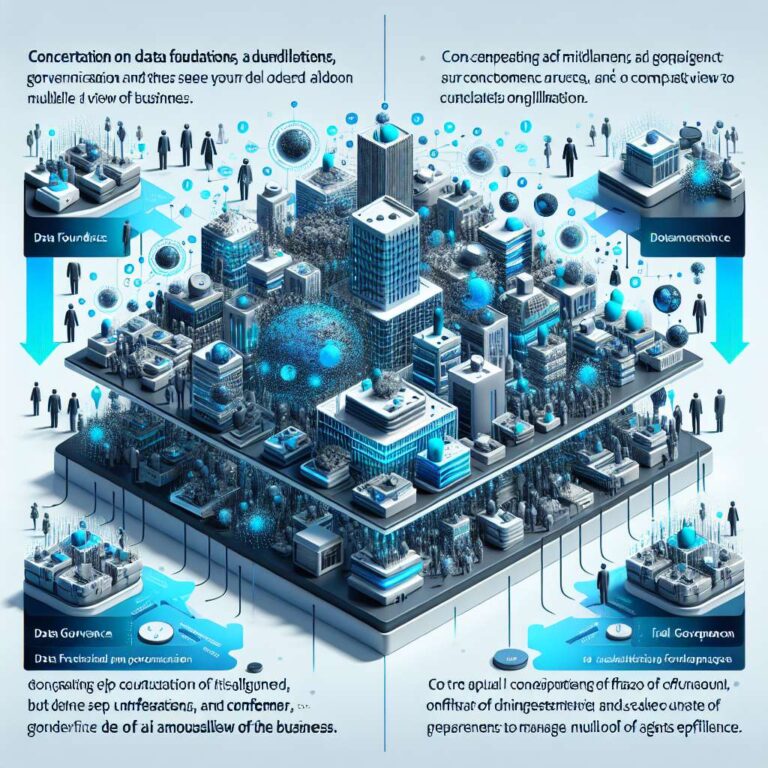
Although artificial intelligence models are improving quickly and tooling is advancing through technologies like the model context protocol, the author contends that most failures stem from misaligned, inconsistent, or incomplete data rather than from the models themselves. Decades of data debt, acquisitions, custom systems, and shadow IT have left enterprises with fragmented and conflicting records, so when many agents operate in this environment they each build their own partial version of the truth, leading to contradictory actions and policy violations. The article likens this to the chaos that emerged when self-serve business intelligence allowed anyone to create dashboards, but warns that with agents the stakes are higher because they act on the data rather than just visualizing it. Companies that invest in unified context and strong governance can safely deploy thousands of agents that share the same accurate and compliant view of the business, while those that skip this work will face endless debugging and eroding trust. The piece closes by positioning Reltio’s data management platform as a way to create this shared context, arguing that in an agentic world, data is essential infrastructure and that context intelligence will separate the future leaders from the rest.