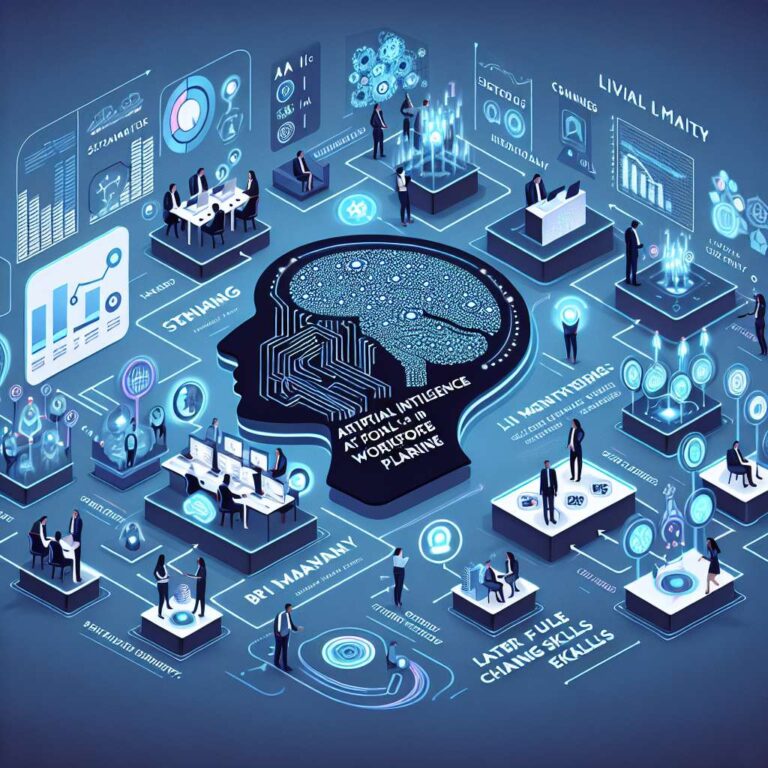
Artificial intelligence is moving from a narrow focus on speeding up recruitment to reshaping workforce planning across the employee lifecycle, argues Cassandra MacDonald of BPP University School of Technology. Traditional workforce planning has relied on historical data, managerial intuition and slowly updated labour forecasts. Artificial intelligence changes this by enabling real-time analysis of internal skills, talent supply and demand, and external labour market trends, so organisations can model future scenarios, anticipate which roles may grow or shrink, pinpoint skills that will become scarce and target training investments where they will deliver the greatest return. MacDonald says businesses need to rethink their relationship with artificial intelligence in the context of how they plan their workforces, treating it as a strategic planning capability rather than a narrow hiring tool.
A central shift described in the article is from job-based to skills-based hiring and planning, with artificial intelligence extracting and inferring skills from job descriptions, CVs and performance reviews. This creates a live skills inventory that helps HR understand organisational capability and transferable skills, supports demand modelling by linking product roadmaps, transformation programmes and regulatory change to skills requirements, and enables tailored learning to close gaps faster. Through predictive analytics and simulation, artificial intelligence can support scenario-based planning, forecasting attrition and internal mobility by role, location and skills cluster, and letting HR test “what if” scenarios to understand the talent, cost and time-to-competency implications. It can also compare hiring, training and contractor options on cost, time-to-productivity, quality and risk so HR can build stronger business cases, such as identifying adjacent skills in a local council for low-code automation projects and upskilling internal staff instead of hiring new developers or relying on contractors.
MacDonald highlights how artificial intelligence can broaden access to opportunities for internal candidates, who are often overlooked when employers focus narrowly on past job titles. Recommendation systems can surface internal applicants based on verified and inferred skills, propose projects and stretch assignments, and act as a career coach by suggesting aspirational roles, which boosts internal mobility and retention. In retail, for example, artificial intelligence could reveal store managers with data skills suitable for forecasting or stock analytics secondments, reducing external hires and strengthening future leadership pipelines. To avoid being disrupted, organisations are urged to adopt a proactive strategy: invest in skills mapping and analytics, embed continuous learning through artificial intelligence-powered personalised training, and redesign jobs around uniquely human strengths while using artificial intelligence to augment rather than replace people. Ethical principles and human accountability must guide artificial intelligence-driven workforce decisions, with explicit attention to transparency and bias. MacDonald concludes that when used responsibly, artificial intelligence can turn workforce planning from a static exercise into a dynamic system that builds capability faster and expands career development opportunities.