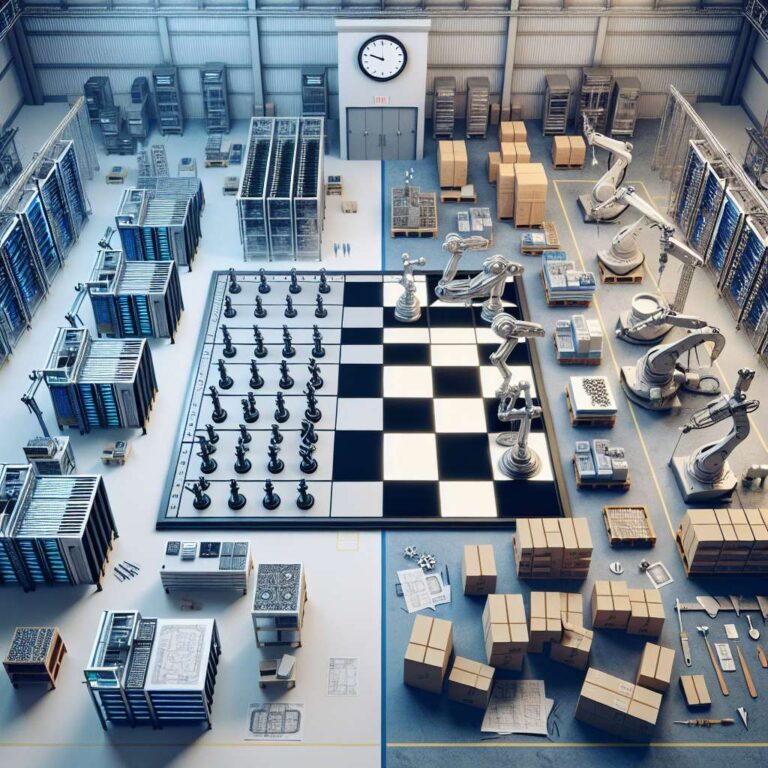
The US and China are competing for dominance in Artificial Intelligence, but their strengths are different. The US has led in Artificial Intelligence “brains”, including chatbots, microchips, and large language models, while China has been stronger in Artificial Intelligence “bodies”, especially robots and humanoid machines. That division is increasingly blurred as both countries try to prevent the other from securing a lasting lead in a technology with major commercial and geopolitical consequences.
The American advantage in large language models grew quickly after OpenAI released ChatGPT on 30 November 2022. OpenAI claims that more than 900 million people now use ChatGPT every week. US companies including Anthropic, Google, and Perplexity then spent billions of US dollars building rival systems. Washington has focused heavily on the hardware behind those models, especially high-end chips largely designed by Nvidia. In October, Nvidia became the first company in the world to be valued at $5tn (£3.8tn). The US has also tightened export controls, strengthened in 2022, to limit China’s access to advanced chips and to chipmaking equipment produced by ASML in the Netherlands.
China responded by showing it could build competitive large language models despite those restrictions. In January 2025, DeepSeek launched as a free chatbot with capabilities described as broadly similar to ChatGPT. DeepSeek is estimated to have cost a fraction of the amount it took to create American LLMs like ChatGPT and Claude. On 27 January 2025, Nvidia suffered the largest single-day market value loss in US stock market history: around $600bn (£450bn). Researchers cited in the report say the export controls may have pushed Chinese developers to become more efficient, while China’s more open source culture lets companies build on one another’s work instead of starting from scratch. One assessment in the report describes Chinese models as maybe only 90% as good, but 10% as expensive.
China’s clearer lead remains in robotics. From the 2010s, Beijing expanded support for robot development through research funding and subsidies. It is now estimated there are about two million working robots in China, more than in the rest of the world combined. In Chongqing, a “dark factory” reportedly uses 2,000 robots and autonomous vehicles and can deliver a new car every minute. China also now accounts for 90% of all humanoid robot exports, helped by its manufacturing base and by domestic demand tied to an ageing population. By around 2035, the number of people [in China] aged 60 or above is expected to exceed the entire population of the US.
Even so, advanced robots still depend on powerful software. Researchers argue the US remains ahead in the chips and agentic Artificial Intelligence needed for robot “brains”, and one estimate says about 80% of the value of a robot is in its brain. That combination is already appearing in industrial systems such as Boston Dynamics’ Spot and in military technologies such as Ukraine’s Gogol-M, which can fly hundreds of kilometers before releasing smaller drones that identify targets autonomously. The likely outcome is not a single decisive winner, but a prolonged contest over capability, economic deployment, and the power to shape global standards.