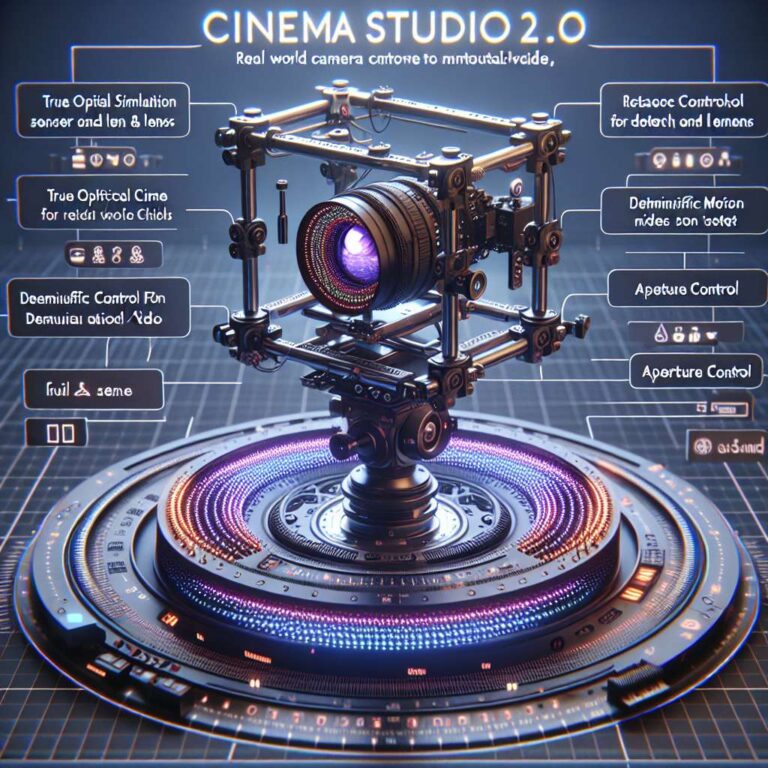
The generative artificial intelligence video market is crowded with tools that turn text prompts into short clips, but many creators find the results unpredictable and hard to control. Camera behavior often feels random, lenses behave inaccurately, and the output can diverge sharply from a director’s vision. Higgsfield, a San Francisco-based artificial intelligence video platform, is targeting this gap with Cinema Studio 2.0, an update designed to give creators cinematography-level control instead of treating video generation as an opaque process.
Cinema Studio 2.0 replaces the typical black-box workflow with what Higgsfield calls a “Hero Frame First” approach, where creators start from a single, carefully crafted image and build motion around it. The platform offers a virtual camera rig that mimics real-world gear, including True Optical Simulation, which lets users choose from different camera sensors and lenses, selecting focal lengths anywhere from 8mm to 50mm. Deterministic Motion Control allows users to instruct specific moves such as tilting up, zooming in, or panning right, with the expectation that the artificial intelligence will follow those directions reliably. Start & End Frame Precision focuses on generating logical, believable transitions between two independent frames, which helps maintain continuity across shots, while Aperture Control governs depth of field and bokeh for both shallow-focus close-ups and deep-focus landscapes.
The release also introduces more ambitious features that blur the line between 2D generation and virtual production. 3D Scene Access allows creators to step inside their images as spatial environments, adjusting composition as if they were navigating a physical set. Genre-Based Motion Logic encodes an understanding that a horror film should move differently from a comedy, tailoring pacing and camera behavior to narrative conventions. Higgsfield emphasizes that these tools are meant to amplify human creativity rather than replace it, and points to creators who have used the platform to secure paid work with clients such as Qatar Airways, Charles & Keith, and NBA-affiliated brands. Version 1.5 of Cinema Studio had already been integrated into professional pipelines at studios including Secret Level, Vertex CGI, and Bazelevs, signaling to independent creators that the same production-grade capabilities are within reach for anyone willing to learn. As generative video matures from spectacle toward utility, Higgsfield is betting that the future belongs to directors who need control and consistency, not just casual users typing prompts.