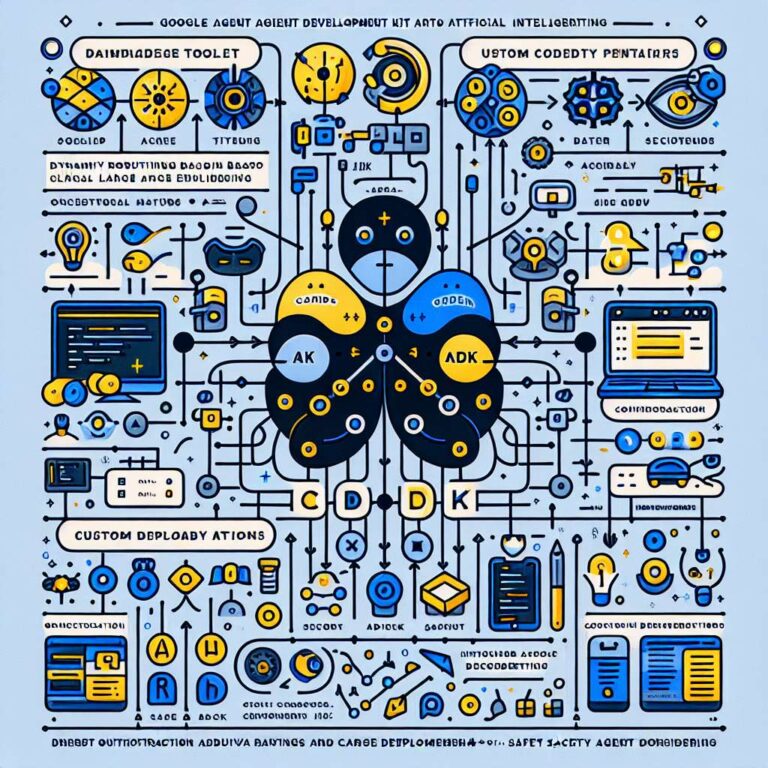
Google’s agent development kit (ADK) is presented as a flexible and modular framework for developing and deploying artificial intelligence agents, with a strong emphasis on making agent development feel more like traditional software development. The kit is optimized for Gemini and the Google ecosystem but is described as model-agnostic and deployment-agnostic, and it is built for compatibility with other frameworks. ADK is intended to help developers more easily create, deploy, and orchestrate agentic architectures that can handle everything from simple, single-purpose tasks to complex, multi-step workflows.
The article highlights recent releases across multiple programming languages, reflecting ADK’s cross-language support. ADK TypeScript v0.2.0 is officially released and extends the agent development kit to one of the most widely used programming languages, with more details available in a linked blog post. ADK Go release v0.3.0 includes numerous bug fixes, introduces new features such as agent-to-agent request callbacks and extendability, and updates dependencies like the GenAI SDK and the ADK Web UI, with full information provided in linked release notes. Installation commands are given for each supported language, including Python via “pip install google-adk”, TypeScript via “npm install @google/adk”, Go via “go get google.golang.org/adk”, and Java via Maven or Gradle snippets that reference version “0.3.0”.
Core capabilities are organized around orchestration, architecture, tools, deployment, evaluation, and safety. For orchestration, developers can define workflows using workflow agents, including Sequential, Parallel, and Loop agents, for predictable pipelines, or they can use LlmAgent transfer for large language model driven dynamic routing and more adaptive behavior. ADK encourages multi-agent architectures, enabling developers to compose multiple specialized agents in a hierarchy to support complex coordination and delegation. The tool ecosystem allows agents to be equipped with capabilities such as pre-built search and code execution tools, custom functions, integrations with third-party libraries, and even using other agents as tools. For deployment, ADK supports containerization and lets teams run agents locally, scale them with Vertex AI Agent Engine, or integrate into custom infrastructure using Cloud Run or Docker. Built-in evaluation features allow systematic assessment of both final response quality and step-by-step execution trajectories against predefined test cases. The documentation also stresses building safe and secure agents, encouraging developers to incorporate security and safety patterns and best practices directly into agent design.