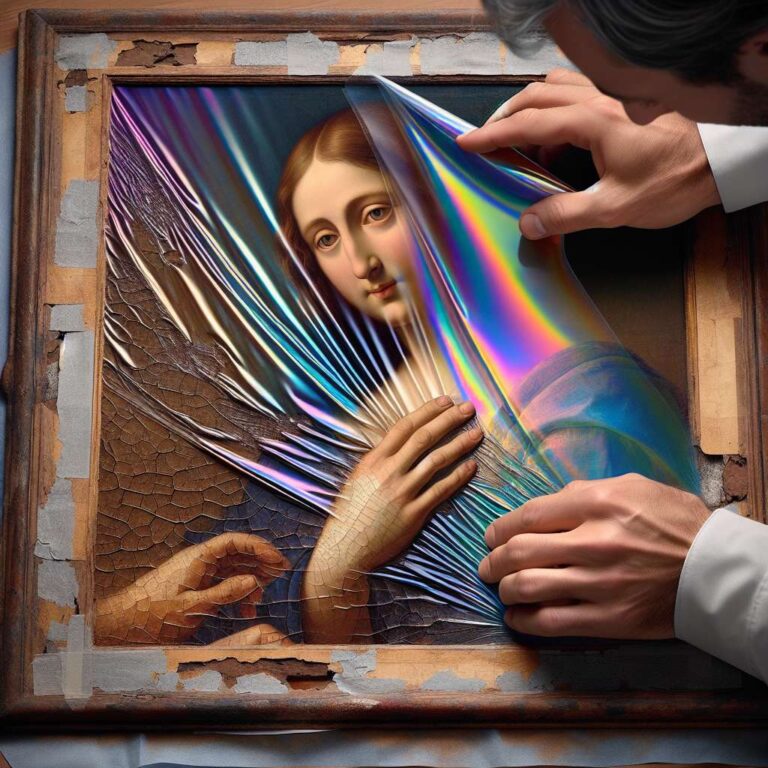
Art restoration is traditionally slow and manual, but a new method developed by Alex Kachkine, SM ’23, uses Artificial Intelligence and printed polymer films to apply digital repairs directly onto original canvases. Digital restoration techniques such as computer vision, image recognition, and color matching have produced virtual or printed reconstructions before, but they have not been applied onto originals. Kachkine’s approach aims to bridge that gap by translating computational restorations into a physical mask that can be aligned, adhered, and later removed if needed.
For his demonstration on a highly damaged 15th-century oil painting he owned, Kachkine first cleaned the work and removed prior restoration attempts, then scanned the painting including areas of loss and cracking. He used existing algorithms to generate a virtual reconstruction and his own software to map regions needing infill and the exact colors required. The process automatically identified 5,612 regions in need of repair and specified 57,314 different shades. That information was converted into a two-layer mask printed onto polymer-based films: one layer in color and a second identical pattern in white. High-fidelity commercial inkjets produced the prints, which were carefully aligned using computational tools before being overlaid by hand.
The printed films were adhered to the painting with a thin spray of conventional varnish and are made from materials that can be dissolved to reveal the original surface, preserving reversibility. The entire workflow took about 3.5 hours, which Kachkine estimates is roughly 66 times faster than traditional restoration methods. He stresses that conservators should participate at every step to respect artistic intent and that the digital mask file can be saved as an exact record of interventions. The method is presented as a way to make many stored, damaged works more accessible for viewing and study while maintaining documentation and removability.