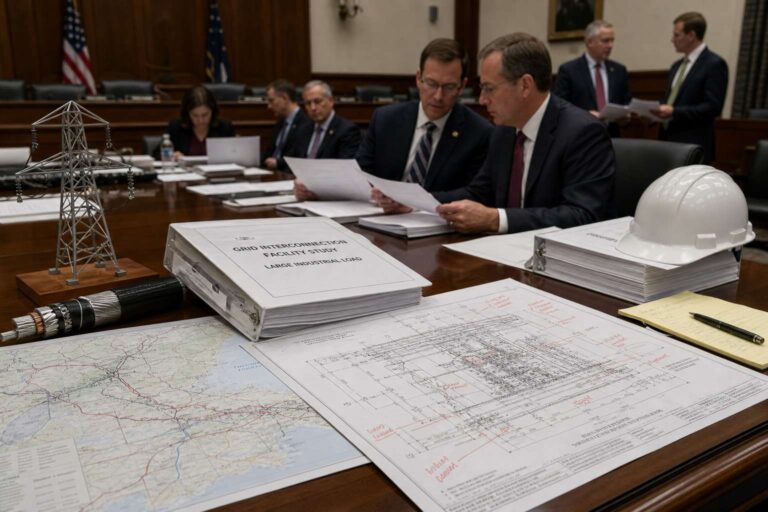
The Federal Energy Regulatory Commission has issued large-load interconnection actions that set national policy for connecting major new power users, including AI factories, semiconductor fabrication support systems and advanced manufacturing facilities. The framework follows a directive from U.S. Secretary of Energy Chris Wright and is designed to modernize the interconnection queue, lower energy costs, expand industrial capacity and strengthen grid reliability.
Large customers would play a more active role in the infrastructure they require by funding network upgrades, bringing new energy generation online and offering flexible load to help grid operators manage peaks. Customers able to shift or curtail demand in response to grid conditions could receive accelerated review, with study periods potentially as short as 60 days.
The policy is presented as a way to spread fixed grid costs across broader electricity demand. Lawrence Berkeley National Laboratory found that every 10% increase in state electricity consumption correlates with an approximately 6-cents-per-kilowatt-hour reduction in retail electricity prices. North Dakota added 23 data centers and saw the nation’s largest electricity price decrease, while PG&E has forecast that each new 1 gigawatt of data center load could reduce electric rates by 1-2% under the right conditions.
NVIDIA and Emerald AI are working with energy partners on AI factories designed as flexible grid assets that bring their own generation, respond to grid conditions in real time and help stabilize surrounding communities. Commercial deployment begins later this year.