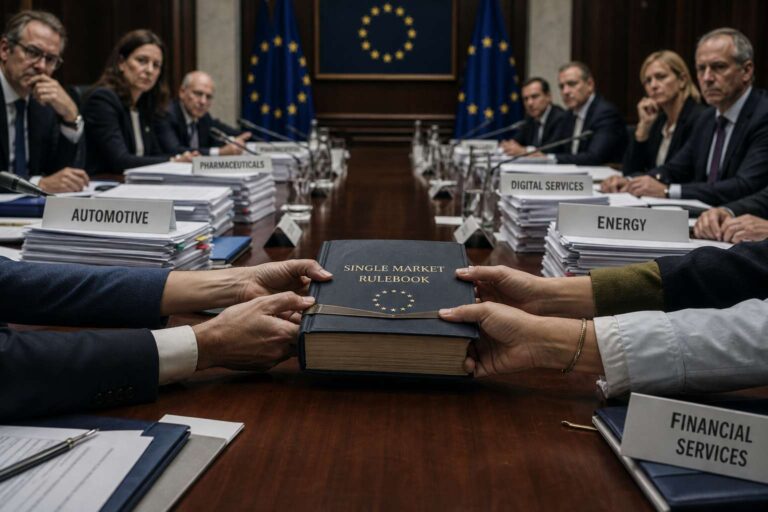
European Union countries and European Parliament lawmakers failed to reach a deal on proposed changes to the bloc’s landmark Artificial Intelligence rules after 12 hours of negotiations on Tuesday. Talks are expected to resume next month, with people familiar with the discussions saying the next round will likely take place in two weeks’ time.
The proposed revisions are part of the European Commission’s Digital Omnibus, an effort to simplify digital regulations and help businesses compete with rivals in the United States and Asia. The Artificial Intelligence Act entered into force in August 2024, with key elements set to be enforced in stages starting this year. The law is widely regarded as the world’s strictest framework for governing the technology, reflecting concerns about effects on children, workers, companies and cybersecurity.
Negotiations were held up by demands from some countries and some lawmakers to exempt industries already covered by sectoral rules, including product safety regulations, from the Artificial Intelligence legislation. A Cypriot official said it was not possible to reach an agreement with the European Parliament. Cyprus currently holds the rotating European Union Council presidency.
The regulation imposes stricter requirements on uses of the technology in high-risk areas such as biometric identification, utilities supply, health, creditworthiness and law enforcement. The Omnibus package also covers the General Data Protection Regulation, the e-Privacy Directive and the Data Act. Proposed changes to those rules and to the Artificial Intelligence Act have drawn criticism from privacy activists and civil rights groups, who argue the effort amounts to yielding ground to Big Tech.
Dutch lawmaker Kim van Sparrentak said the failed talks would be welcomed by large technology companies, while European businesses that prioritized safety and prepared for compliance now face regulatory uncertainty. The impasse leaves unresolved whether existing sector-specific oversight will be enough for some industries or whether the bloc will keep a broader cross-sector framework under its Artificial Intelligence law.