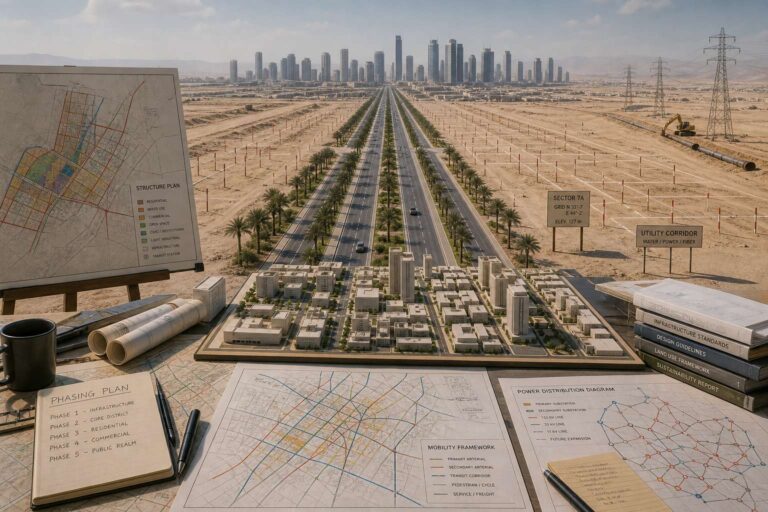
Egypt is moving ahead with The Spine, a USD 27bn mixed-use city backed by Talaat Moustafa Group and developed in partnership with the National Bank of Egypt. According to Reuters, the project will span approximately 2.4 million m2 and is positioned as one of the region’s largest urban investments. Integrated with TMG’s Madinaty development, it is planned as a Special Investment Zone combining residential, commercial, hospitality and entertainment functions in one continuous environment.
At roughly 1.4 trillion Egyptian pounds in investment, the development is projected to generate approximately 818 billion Egyptian pounds in tax revenues over time and create more than 55,000 direct jobs, alongside hundreds of thousands of indirect roles, according to Reuters. The city is being designed as a fully integrated digital and physical system, centred on a city-wide digital twin using real-time geospatial simulation tools such as Nvidia Omniverse and Cesium. Live Internet of Things data will support continuous modelling of traffic, utilities and emergency scenarios, enabling predictive city operations instead of reactive management.
This architecture will be supported by five edge data centres and more than 200 micro-edge nodes to handle low-latency Artificial Intelligence workloads. The infrastructure is designed to process millions of real-time events per second through streaming platforms such as Apache Kafka and federated data systems that reduce central bottlenecks. Artificial Intelligence agents will manage resources across the city, including adaptive traffic control for emergency response, while privacy protections will keep sensitive raw video and personal data on local devices rather than moving it into central systems.
Predictive maintenance and energy management are central to the design. Using fibre-optic sensing and models such as temporal convolutional networks, the system can detect structural stress or pipeline issues up to two weeks in advance and trigger automated maintenance using drones and robotic units. Reinforcement learning models will also coordinate microgrids that combine solar power, battery storage and vehicle-to-grid systems, with the aim of optimising consumption and supporting participation in local energy markets.
The Spine is expected to grow from an initial population of 30,000 to around 180,000 residents, and its digital architecture is being built to scale through semi-independent districts with local Artificial Intelligence agents. Federated learning will allow models to train within districts while sharing only encrypted updates, helping address data sovereignty concerns as data volumes rise to an estimated 2 petabytes annually. The project also includes a digital economic twin to model tax revenue and job creation, alongside investor and tenant portals, a data marketplace and a venture studio intended to attract businesses and startups. Governance measures include observability tools, non-Artificial Intelligence fallback systems for safety-critical functions and quarterly red teaming exercises to test resilience against overloads and cyber-physical threats.