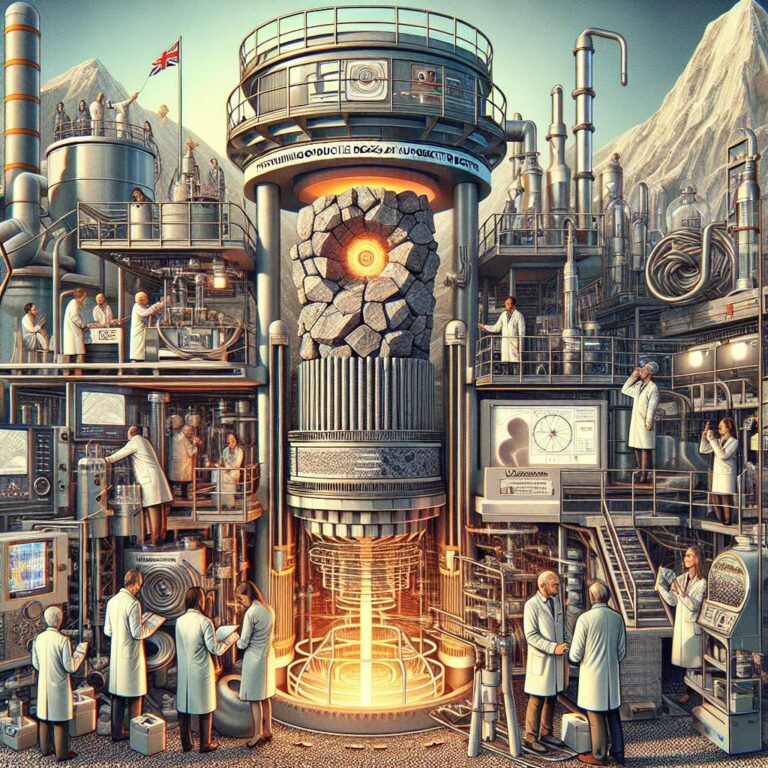
Researchers at the Swiss Federal Institute of Technology Lausanne have demonstrated that rock formations remain fractureable even in the ductile regime at supercritical depths, a finding they say could expand the viability of geothermal energy worldwide. Detailed in Nature Communications by the Laboratory of Experimental Rock Mechanics, the study shows that water can circulate in deep, high temperature rock once fractures are created, challenging long held assumptions that the brittle ductile transition marked the lower limit for effective fluid flow. By enabling engineered pathways in these conditions, the work positions geothermal energy as a more universally deployable, clean baseload source.
The study focuses on the supercritical domain reached several miles below ground, where water exceeds about 750 degrees Fahrenheit and behaves with both liquid and gas properties. This supercritical fluid can carry much more heat than conventional geothermal water, which could boost plant output by up to an order of magnitude compared to traditional systems. The hurdle is access. While the Kola borehole’s roughly 7.5 mile depth stands as a notable benchmark, scaling supercritical geothermal would require deeper, hotter wells in many locations. If drilling to these conditions can be achieved reliably and economically, the article notes that super deep geothermal could be sited broadly, including at former coal power plant locations that already have grid connections and steam cycle infrastructure.
EPFL’s team, led by Gabriel Meyer, replicated extreme subsurface conditions using a triaxial gas apparatus and 3D imaging with a synchrotron to observe rock behavior across the brittle to ductile transition. They report that although the rock deforms plastically over time, rapid stress changes can still induce fracturing, similar to how a viscoelastic material can both flow and break depending on the rate of applied force. This overturns the view that ductile rocks cannot be effectively fractured for circulation and suggests new operating windows for engineered geothermal systems in hotter, deeper crustal zones.
Beyond the lab, the article points to companies exploring technologies that could make super deep drilling feasible. Quaise Energy is investigating particle accelerator based methods originally developed for fusion research, while firms such as Fervo Energy and Sage Geosystems have already demonstrated modern fracturing techniques in conventional geothermal projects. If drilling and stimulation approaches mature for supercritical conditions, the authors argue that geothermal output and siting flexibility could expand significantly, reshaping the energy mix with a stable, low carbon resource.