
Enhancing Ai Assisted Cosmetics with OKRs

Discover how the Objective and Key Results framework can transform AI-assisted cosmetics, maximizing efficiency and innovation.

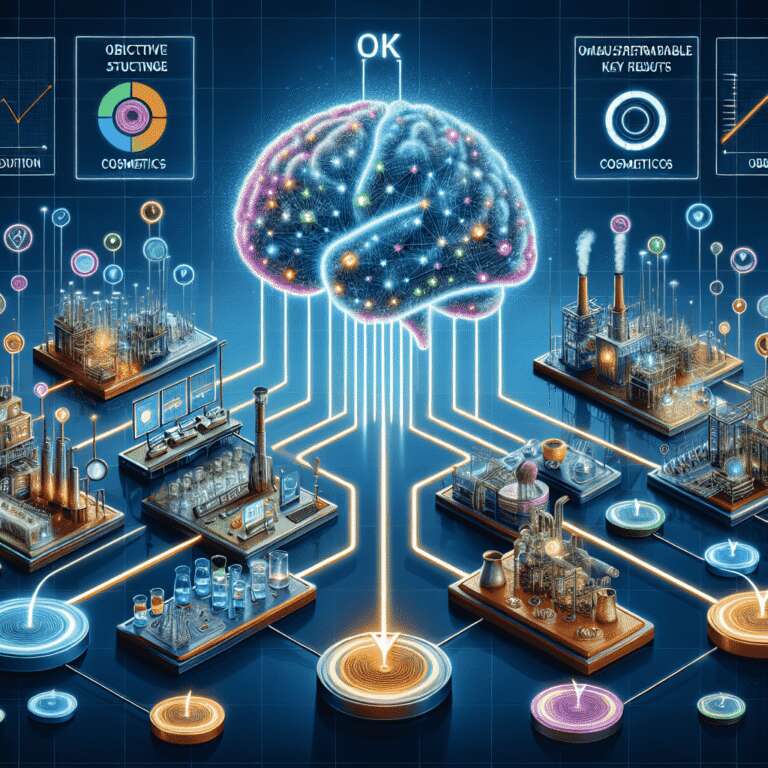
The article explores the implementation of the Objective and Key Results (OKR) framework in the development of Artificial Intelligence-assisted cosmetics. OKRs, introduced by Intel in the 1970s and popularized by Google in the 1990s, provide a structured approach to setting and tracking ambitious goals. The methodology shifts focus from mere project completion to achieving measurable outcomes, making it ideal for teams striving for significant advancements in their fields.

To facilitate the creation of effective OKRs tailored to the AI-assisted cosmetics sector, tools such as Tability AI are highlighted. This tool enables users to quickly generate editable OKR templates based on specific prompts. With Tability Feedback, existing OKRs can be refined through AI-driven analysis, offering suggestions ranging from minor improvements to complete overhauls. These tools are positioned as instrumental in enhancing the precision and effectiveness of goal-setting in the industry.

The article provides practical examples of OKRs aimed at launching AI-enhanced cosmetics prototypes in collaboration with Korean OEM factories. Strategic initiatives included in the templates illustrate the difference between objectives, measurable key results, and actionable initiatives. Additional best practices are shared to optimize the use of OKRs, emphasizing the importance of weekly check-ins, limiting key results, and maintaining urgency through proactive status assessments. This guidance supports teams in achieving their goals while saving time with automated OKR dashboards and insights.
55

Impact Score

Congress weighs Artificial Intelligence transparency rules

Bipartisan lawmakers are pushing a federal transparency standard for the largest Artificial Intelligence models as Congress works on a broader national framework. The proposal aims to increase public trust while avoiding stricter state-by-state requirements and heavier regulation.

Report finds California creative job losses are not driven by Artificial Intelligence

New research from Otis College of Art and Design finds California’s recent creative industry job losses stem from cost pressures and structural shifts, not direct worker displacement by generative Artificial Intelligence. The technology is changing workflows and expectations, but it is largely replacing tasks rather than entire jobs.

U.S. senators propose broader chip tool export ban for Chinese firms

A bipartisan proposal in the U.S. Senate would shift semiconductor equipment controls from specific fabs to targeted Chinese companies and their affiliates. The measure is aimed at cutting off access to advanced lithography and other wafer fabrication tools for firms such as Huawei, SMIC, YMTC, CXMT, and Hua Hong.

Trump executive order targets state Artificial Intelligence laws

Executive Order 14365 lays out a federal strategy to discourage, challenge, and potentially preempt state Artificial Intelligence laws viewed as burdensome. Employers are advised to keep complying with current state and local rules while preparing for regulatory uncertainty in 2026.

Who decides how America uses Artificial Intelligence in war

Stanford experts are divided over how the United States should govern Artificial Intelligence in defense, surveillance, and warfare. Their views converge on one point: decisions with such high stakes cannot be left to companies alone.

Contact Us

Got questions? Use the form to contact us.

Contact Form

Clicking next sends a verification code to your email. After verifying, you can enter your message.