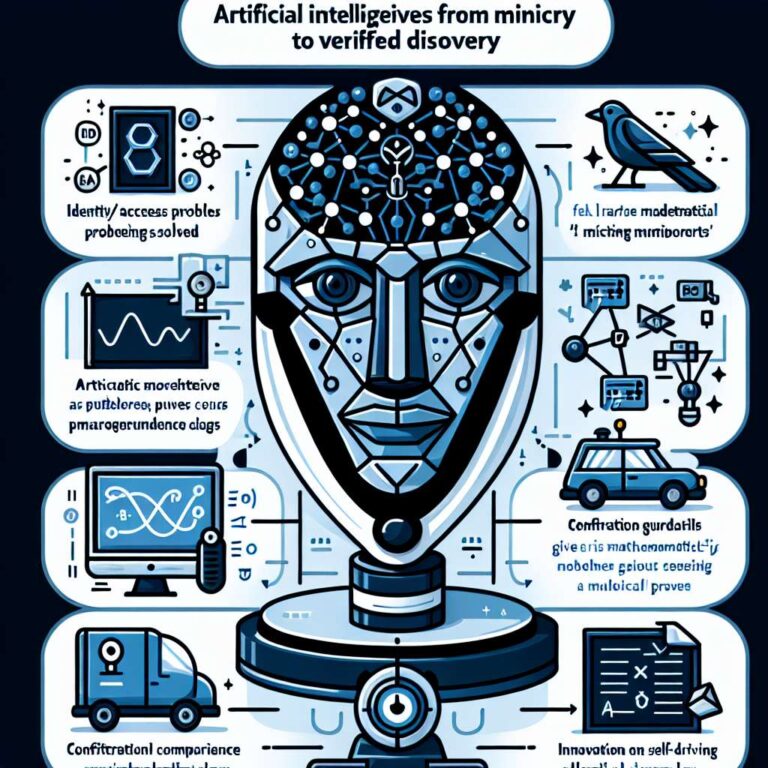
The article argues that a recent mathematical breakthrough marks the end of the comforting notion that Artificial Intelligence systems are merely “stochastic parrots” that remix existing text without genuine discovery. The author explains that critics, following linguist Emily M. Bender, long described large models as next word predictors with no capacity for original insight, but that a new result linked to Erdős Problem #728 materially challenges this view. According to the piece, the consensus that Artificial Intelligence could only mirror the past and not solve previously unsolved problems no longer holds.
The turning point centers on Erdős Problem #728, a factorial divisibility puzzle originally posed by Paul Erdős in 1973 that remained unresolved for more than fifty years because of ambiguities in its statement. On Jan. 6, 2026, the global mathematical community clarified the problem’s constraints, and on Jan. 12, 2026, a research team posted a resolution to arXiv that the author describes as a clean room test for Artificial Intelligence. Because the corrected version of the problem had existed for only a few days before its resolution, the risk of data contamination was materially reduced, and to the best of current knowledge no prior resolution existed in the model’s training corpus. With human steering and a formal verification tool named Aristotle, developed by Harmonic, a frontier model identified as GPT-5.2 Pro synthesized a novel strategy that was then formally verified in Lean style tools, producing a proof that observers described as having an “alien” feel because it bypassed standard human pedagogical steps.
The article frames this as a shift from autocomplete to verified discovery, arguing that formal verification allows organizations to mathematically guarantee the correctness of statements in domains that can be precisely formalized, even though it does not validate the real world assumptions behind those statements. In practical terms, the author says this enables leaders to move from guessing to proving in areas such as identity and access management, pricing guardrails, and configuration compliance. For Canadian professionals, the author contends that this demands a new mindset where Artificial Intelligence is treated not as a chore saving tool but as a cognitive partner in an era of compressed innovation, exemplified by the University of Toronto’s Acceleration Consortium using “self driving labs” for materials discovery in a fraction of the usual time and cost. The piece concludes that as we move through 2026, competitive advantage will go to leaders who recognize that Artificial Intelligence can now do things that have never been done before and who act on three immediate steps: identifying formalizable domains, piloting verifier workflows, and building governance to distinguish advisory Artificial Intelligence from verified Artificial Intelligence with clear human sign off.