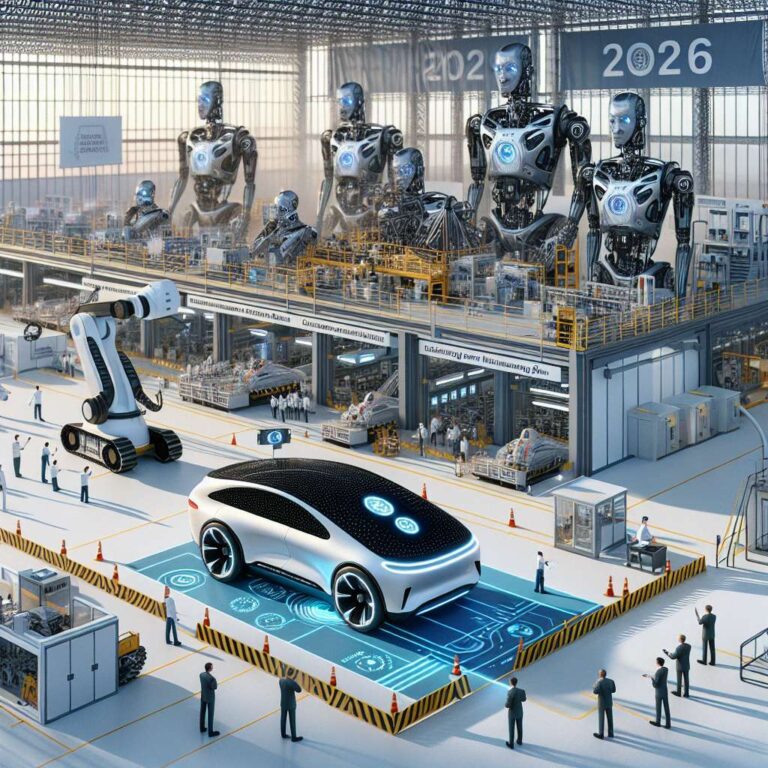
Elon Musk has set a firm 2026 deadline for Tesla’s artificial intelligence division to deliver major breakthroughs in autonomous driving and humanoid robotics, a move portrayed as the “hardest year” yet for the company’s engineers. The push centers on rolling out unsupervised Full Self-Driving capabilities and scaling production of the Optimus humanoid robot, with factory deployment of Optimus Gen 3 targeted by late 2025 and mass production in 2026. Musk touts a “clear path” to doubling artificial intelligence performance metrics within months and points to Tesla’s in-house chips, already embedded in millions of vehicles and data centers, as a competitive strength, while Tesla’s artificial intelligence chief and external reports depict an extremely demanding period for Autopilot and Optimus teams.
Engineers reportedly face grueling schedules as they work to compress massive volumes of real-world driving data into predictive models that mimic human decision-making, a photon-to-action pipeline Musk describes as central to both Full Self-Driving and Optimus. The company is leveraging its vehicle fleet for continuous data collection, feeding into large training cycles that support unoccupied Robotaxi tests and early unsupervised operations highlighted in posts on X and coverage in Teslarati. At the same time, Musk and his artificial intelligence director acknowledge technical setbacks, including how training too heavily on rare edge cases can degrade everyday driving smoothness, underscoring a trial-and-error process of rolling out new models, debugging regressions, and rebalancing safety and comfort.
Externally, competition and scrutiny are mounting. Musk publicly rejected former artificial intelligence chief Andrej Karpathy’s comparisons of Tesla to Waymo, arguing in comments relayed by The Times of India that Tesla’s “intelligence density” per gigabyte surpasses rivals by an order of magnitude. Reports from GB News and others note that this rhetorical confidence coincides with investigations into vehicle defects, declining European sales, and stock volatility as investors weigh Tesla’s software lead against execution risk. Musk’s broader artificial intelligence ambitions through his xAI venture, including a prediction of artificial general intelligence by 2026 after revising a previous 2025 forecast, suggest potential synergies but also raise doubts from critics who see a pattern of optimistic timelines used to attract talent and capital.
Behind the scenes, Tesla is contending with what Musk calls the “craziest” talent war for artificial intelligence experts, with over 200 engineers driving autonomy efforts amid fears of burnout. Musk has warned on X that “people will die” if unproven systems are rushed, framing the stakes around safety even as he pushes for rapid feature rollouts and international expansion, including plans mentioned for Full Self-Driving in the UAE by January 2026. OpenTools AI and other sources cited in the piece describe plans for producing a million Optimus units annually, positioning the robot as a potentially transformative factory tool that could reshape manufacturing and logistics. Industry coverage from Success Quarterly, IndexBox, The Guardian, Benzinga, and others situates Tesla’s 2026 mandate within a broader arms race for artificial intelligence compute and applications, where Musk aims for xAI to amass more processing power than all competitors combined within five years and for Tesla to compress real-world intelligence into efficient, deployable systems.
The article emphasizes that the outcome of Musk’s 2026 gambit will help determine whether Tesla secures a durable lead in real-world artificial intelligence or faces reputational damage from missed milestones and overextended staff. Observers warn that the road to unsupervised Full Self-Driving, mass-produced Optimus robots, and potential Robotaxi networks is fraught with data bottlenecks, hardware limits, and regulatory and ethical concerns about deploying life-critical systems at scale. Yet Musk and Tesla leadership continue to project confidence in X posts and media citations, praising accelerated autonomy progress despite a severe hiring crunch and external headwinds. The piece closes by framing 2026 as a defining test of Tesla’s integrated strategy, where success could reshape transportation, robotics, and everyday artificial intelligence use, while failure would expose the costs of Musk’s relentless deadlines and audacious promises.