
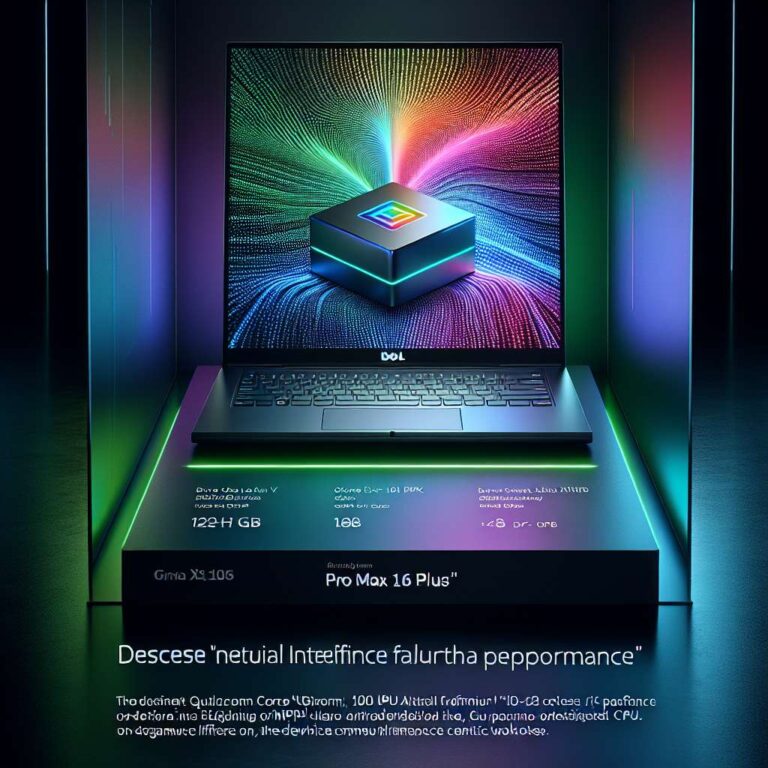
Dell ships Pro Max 16 Plus with Qualcomm discrete Artificial Intelligence NPU

Dell's Pro Max 16 Plus includes a Qualcomm Artificial Intelligence-100 Ultra discrete NPU delivering 870 INT8 TOPS and 128 GB of LPDDR5X memory, enabling local models up to 120 billion parameters on the NPU alone.

Dell has started shipping the Pro Max 16 Plus configured with a discrete Qualcomm Artificial Intelligence-100 Ultra neural processing unit. The NPU is rated at 870 INT8 TOPS and operates within a 150 W TDP envelope. Dell pairs the NPU with up to 128 GB of LPDDR5X memory on select models, which the company says provides enough compute and memory capacity to run local Artificial Intelligence models with up to 120 billion parameters on the NPU without requiring additional external memory or compute resources.

The Pro Max 16 Plus combines the Qualcomm NPU with robust CPU options, including up to an Intel Core Ultra 9 285HX vPro with 24 cores. To accommodate the NPU, Dell has removed the traditional discrete GPU from the system. Graphics output is handled by the integrated GPU within the Arrow Lake-HX chip, which Dell positions as suitable for basic display tasks but not for gaming. Dell describes the tradeoff as intentional: the dedicated NPU is intended for Artificial Intelligence developers and consumes the space, power, and cooling headroom that a discrete GPU would normally occupy.

For local development workflows the laptop uses the Qualcomm NPU for model inference and related workloads, paired with the host CPU and configurations commonly shipping with 64 GB of system memory for broader system tasks. Dell emphasizes the NPUu2019s combination of high TOPS and substantial on-board memory as an alternative to a conventional GPU-based design, arguing it offers more computing power and VRAM capacity for on-device Artificial Intelligence workloads. The company positions the Pro Max 16 Plus as a workstation choice focused on AI-centric applications rather than gaming or GPU-accelerated graphics.
56

Impact Score

Congress weighs Artificial Intelligence transparency rules

Bipartisan lawmakers are pushing a federal transparency standard for the largest Artificial Intelligence models as Congress works on a broader national framework. The proposal aims to increase public trust while avoiding stricter state-by-state requirements and heavier regulation.

Report finds California creative job losses are not driven by Artificial Intelligence

New research from Otis College of Art and Design finds California’s recent creative industry job losses stem from cost pressures and structural shifts, not direct worker displacement by generative Artificial Intelligence. The technology is changing workflows and expectations, but it is largely replacing tasks rather than entire jobs.

U.S. senators propose broader chip tool export ban for Chinese firms

A bipartisan proposal in the U.S. Senate would shift semiconductor equipment controls from specific fabs to targeted Chinese companies and their affiliates. The measure is aimed at cutting off access to advanced lithography and other wafer fabrication tools for firms such as Huawei, SMIC, YMTC, CXMT, and Hua Hong.

Trump executive order targets state Artificial Intelligence laws

Executive Order 14365 lays out a federal strategy to discourage, challenge, and potentially preempt state Artificial Intelligence laws viewed as burdensome. Employers are advised to keep complying with current state and local rules while preparing for regulatory uncertainty in 2026.

Who decides how America uses Artificial Intelligence in war

Stanford experts are divided over how the United States should govern Artificial Intelligence in defense, surveillance, and warfare. Their views converge on one point: decisions with such high stakes cannot be left to companies alone.

Contact Us

Got questions? Use the form to contact us.

Contact Form

Clicking next sends a verification code to your email. After verifying, you can enter your message.