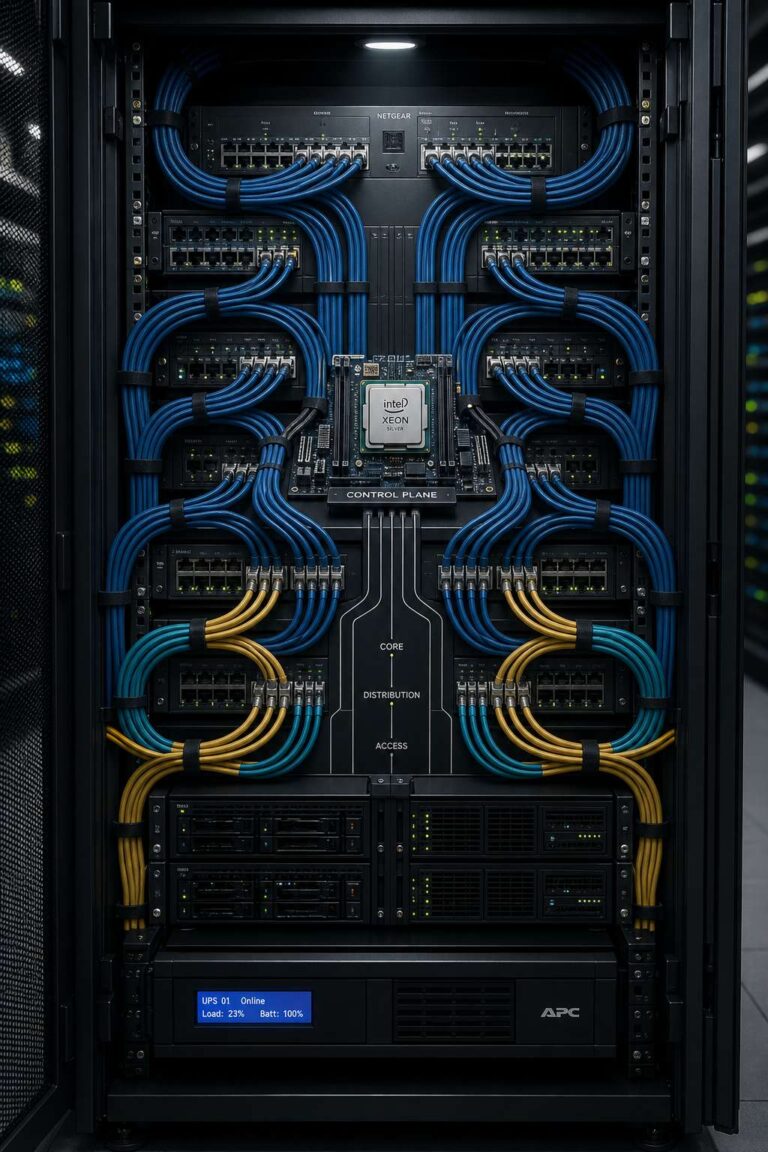
Intel has unveiled a new wave of data center hardware aimed at supporting the rise of agentic Artificial Intelligence, with updates spanning CPUs, networking, and future Artificial Intelligence accelerators. The announcement at Computex in Taipei includes new Intel Xeon 6+ processors, Intel Ethernet E835 networking products, and fresh technical details on Intel’s upcoming Crescent Island GPU platform. The launch points to a shift in chip infrastructure priorities, with greater emphasis on power efficiency, data movement, and scalable Artificial Intelligence inference rather than raw accelerator performance alone.
The new Xeon 6+ processors extend Intel’s Xeon 6 family with up to 288 Efficient-cores and are built on Intel’s 18A process technology, marking the first time the node is being used in a data center CPU. Intel is positioning the chips for cloud-native and Artificial Intelligence-heavy workloads where concurrency, latency, and rack density are becoming critical constraints. According to Intel, the processors can deliver up to 2.5x higher performance than the previous generation while improving performance-per-watt against competing products.
The processors also support 12-channel DDR5 memory, PCIe Gen 5, CXL connectivity, and integrated security technologies including Intel SGX and TDX. Intel says the chips are already being tested in telecom infrastructure and integrated into systems from vendors including ASUS, Dell Technologies, Ericsson, HPE, Lenovo, and Supermicro. Kevork Kechichan, executive vice president and general manager of Intel Data Center Group, described the CPU as the control plane for modern Artificial Intelligence infrastructure as workloads become more agentic and constrained by orchestration, concurrency, and data movement.
Alongside the CPU launch, Intel expanded its Ethernet portfolio with the E835 controllers and network adapters, supporting data rates up to 200GbE. The E835 products support RDMA technologies including RoCEv2 and iWARP, while also targeting lower power consumption in dense server deployments. Intel claims its E835-CQDA2 adapter offers significantly better performance-per-watt than comparable products from NVIDIA and Broadcom, with security features including Hardware Root of Trust and signed SPDM support.
Intel also revealed more details about its next-generation Artificial Intelligence accelerator, code-named Crescent Island, based on the Xe 3P architecture. The GPU is designed for large inference workloads and agentic Artificial Intelligence systems, with up to 480GB of LPDDR5x memory and a 350W air-cooled PCIe design. Intel says the platform supports datatypes ranging from FP4 to FP64 and is intended to work with the company’s open software stack for heterogeneous computing environments. Intel also introduced a new 12-core Xeon 6300 processor for SMB entry servers, giving smaller systems access to higher core counts without requiring platform redesigns.