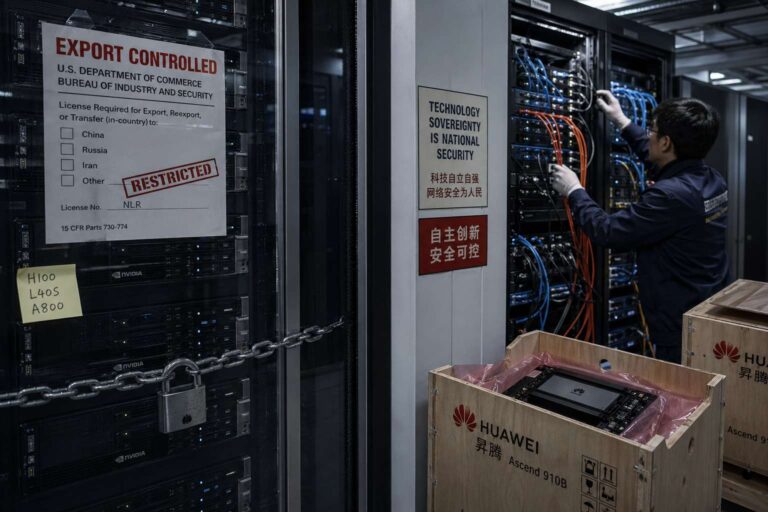
DeepSeek, the Chinese Artificial Intelligence start-up that drew global attention last year with a low-cost model, launched a preview of its new V4 model adapted for Huawei chip technology. The move highlights a much closer collaboration with Huawei and marks a notable shift from DeepSeek’s earlier reliance on Nvidia chips. DeepSeek did not disclose which processors were used to train the latest model, but said the pro version surpasses other open-source models on world-knowledge benchmarks, trailing only Google’s Gemini-Pro-3.1, a closed-source model.
The V4 lineup also includes a lower-cost flash version. DeepSeek said the preview format is intended to gather real-world feedback and allow changes before a final release, but it did not provide a timeline for completion. Huawei said it had worked closely with DeepSeek so the new V4 models could operate across its full range of high-performance systems. “The entire Ascend supernode product line now supports the DeepSeek V4 series models,” Huawei said.
The launch came one day after the White House accused China of stealing US Artificial Intelligence intellectual property on an industrial scale, adding tension ahead of a summit between US and Chinese leaders next month. DeepSeek has become a focal point in that dispute, with Washington alleging it may have violated US export controls by obtaining advanced Nvidia chips for training. Anthropic and OpenAI have also accused the company of improperly distilling their proprietary models.
DeepSeek has acknowledged using Nvidia chips, but has not said whether the chips in question were covered by export bans. The company has said its V3 model used data naturally occurring and collected through Web crawling, and that it had not intentionally used synthetic data generated by OpenAI. The Chinese embassy in Washington rejected what it called baseless allegations and said Beijing places high importance on intellectual property protection.
Huawei’s Ascend Artificial Intelligence chips are central to China’s effort to reduce dependence on advanced US semiconductor technology. Since Washington began restricting China’s access to advanced Artificial Intelligence chips from US companies in 2022, Beijing has accelerated its push for technological self-sufficiency, benefiting domestic chipmakers such as Huawei. DeepSeek’s rapid rise early last year has also helped push low-cost, open-source models to the center of China’s Artificial Intelligence ecosystem, intensifying competition among local rivals.