
Debug-gym: AI Environment for Learning Code Debugging

Discover how debug-gym enables Artificial Intelligence tools to effectively debug code like human programmers.

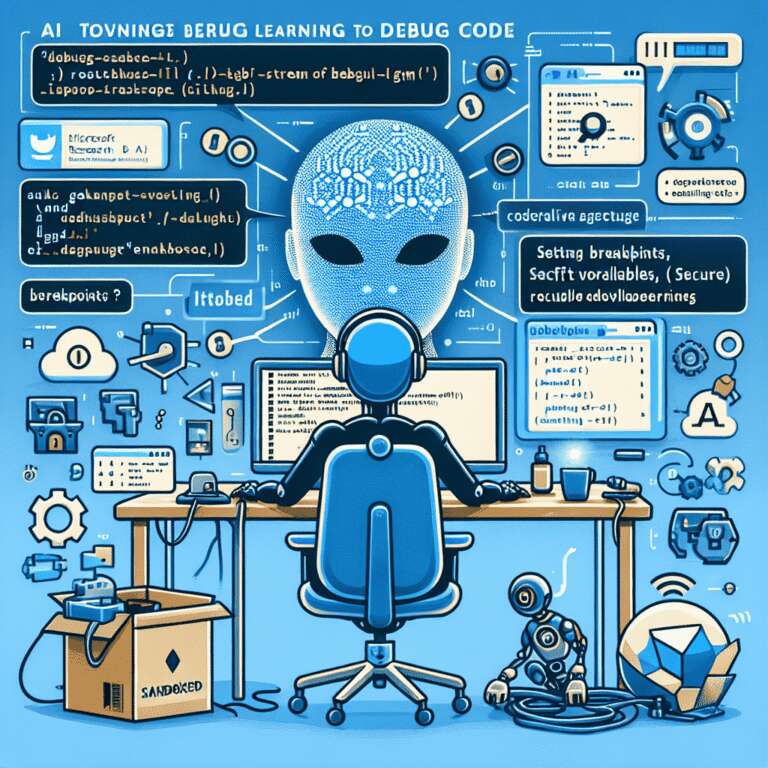
Debugging is a time-consuming task for developers, signifying a key area where Artificial Intelligence tools can greatly assist. Microsoft Research introduces debug-gym, an environment designed to enable AI coding tools to understand and debug code akin to human developers. As AI takes on a larger role in code generation, with predictions that tools like GitHub Copilot will write a significant portion of future code, equipping these tools to debug is essential.

Traditional coding tools struggle with debugging beyond basic suggestions due to their limited ability for active inquiry when encountering complex issues. Debug-gym seeks to address this by providing AI with access to interactive debugging tools, allowing them to perform actions like setting breakpoints, printing variable values, and evaluating code sections interactively. This approach empowers coding agents with the ability to better understand the context and deliver more precise code fixes.

Debug-gym extends the capabilities of current coding agents by incorporating repository-level access and robust security measures through sandboxed environments. It encourages explorative code repair by leveraging structured text actions compatible with state-of-the-art language models. The initiative is part of a broader research effort to enhance AI’s debugging proficiency by fine-tuning interactive capabilities, thus paving the way for a more efficient coding future.

With the development of debug-gym, Microsoft envisions a collaborative future where human programmers approve AI-suggested fixes grounded in comprehensive codebase contexts. Open-source support invites the global research community to contribute towards creating agents adept at interactive debugging, crucial for advancing AI-driven software engineering.
75

Impact Score

Report finds California creative job losses are not driven by Artificial Intelligence

New research from Otis College of Art and Design finds California’s recent creative industry job losses stem from cost pressures and structural shifts, not direct worker displacement by generative Artificial Intelligence. The technology is changing workflows and expectations, but it is largely replacing tasks rather than entire jobs.

U.S. senators propose broader chip tool export ban for Chinese firms

A bipartisan proposal in the U.S. Senate would shift semiconductor equipment controls from specific fabs to targeted Chinese companies and their affiliates. The measure is aimed at cutting off access to advanced lithography and other wafer fabrication tools for firms such as Huawei, SMIC, YMTC, CXMT, and Hua Hong.

Trump executive order targets state Artificial Intelligence laws

Executive Order 14365 lays out a federal strategy to discourage, challenge, and potentially preempt state Artificial Intelligence laws viewed as burdensome. Employers are advised to keep complying with current state and local rules while preparing for regulatory uncertainty in 2026.

Who decides how America uses Artificial Intelligence in war

Stanford experts are divided over how the United States should govern Artificial Intelligence in defense, surveillance, and warfare. Their views converge on one point: decisions with such high stakes cannot be left to companies alone.

GPUBreach bypasses IOMMU on GDDR6-based NVIDIA GPUs

Researchers from the University of Toronto describe GPUBreach, a rowhammer attack against GDDR6-based NVIDIA GPUs that can bypass IOMMU protections. The technique enables CPU-side privilege escalation by abusing trusted GPU driver behavior on the host system.

Contact Us

Got questions? Use the form to contact us.

Contact Form

Clicking next sends a verification code to your email. After verifying, you can enter your message.