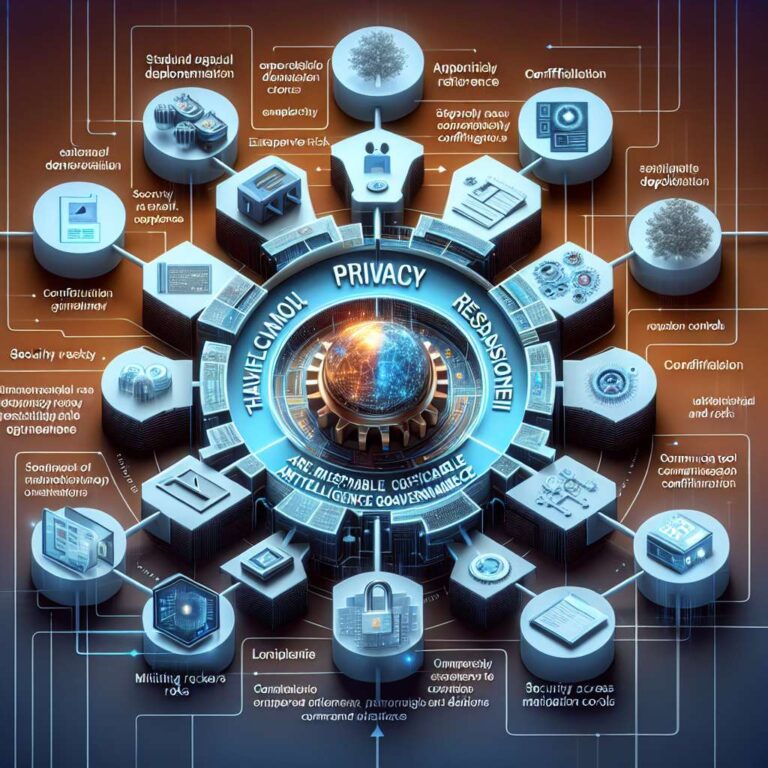
The article marks January 28, 2026 as “Data Privacy Day” and uses the occasion to examine how privacy principles have become central to responsible artificial intelligence governance. The period from 2024 through 2026 has seen rapid development of artificial intelligence regulation, including comprehensive state laws, the EU artificial intelligence act reaching operational applicability, and aggressive federal enforcement signals around algorithmic harms. As artificial intelligence becomes more embedded in business processes, the author argues that privacy is foundational to lawful deployment, compliance, and risk management, spanning issues from training data and inference-time processing to outputs that may reveal proprietary information across diverse regulatory regimes.
The piece details practical privacy risks in artificial intelligence deployment, including prompt injection attacks that can trigger disclosure of sensitive information in training data or system prompts, and inadvertent trade secret exposure when employees input confidential information into public systems that use conversations for model training. It explains how unintended training on proprietary data, the use of personal data in training datasets without clear lawful basis or notice, and algorithmic inferences that qualify as personal data can each create independent privacy obligations. The article also emphasizes re-identification risks, as pattern recognition in artificial intelligence models can undermine traditional anonymization techniques, especially when models are combined with auxiliary data or exploited through inference attacks.
To address these risks, the author outlines core building blocks of artificial intelligence privacy governance across the system lifecycle. Recommended measures include mandatory privacy or data protection impact assessments for systems that process personal information, robust data mapping and inventories, and explainability and transparency mechanisms that can meet rising regulatory expectations around automated decision-making. The article further highlights the need for strengthened security and access controls, continuous monitoring and testing for data leakage, bias, drift, and privacy vulnerabilities, and structured vendor risk management that scrutinizes how third-party providers use inputs, support data subject rights, and implement security and incident response. Workforce training and clear policies against feeding sensitive data into public tools are presented as essential safeguards.
A substantial section focuses on privacy settings in commercial artificial intelligence tools as a practical control where private, internally hosted models are not feasible. The article describes how ChatGPT, Gemini, and Claude each offer default configurations that allow use or review of conversations for model improvement, and explains that organizations should require employees to disable these settings or use enterprise licenses where “Opt-Out of Training” is typically enabled by default. It urges corporate policies that mandate disabling training on inputs and outputs, favor temporary or ephemeral chat modes, and prohibit entry of personal information, trade secrets, or privileged communications regardless of settings, while applying similar configuration requirements to other authorized tools, including Microsoft Copilot and industry-specific applications. Organizations are advised to operate on the assumption that all employee interactions with public-tier artificial intelligence systems are discoverable in litigation and regulatory investigations unless enterprise privacy settings are contractually enabled and technically verified.
The article then addresses multi-jurisdictional compliance, suggesting that organizations find common ground across overlapping frameworks by establishing broad transparency baselines, building infrastructure to honor individual rights such as access, correction, deletion, and objection to automated decisions, and using consistent methodologies to identify “high-risk” systems in domains like employment, education, credit, housing, healthcare, and essential services. It notes that robust human oversight of consequential artificial intelligence decisions and comprehensive vendor management standards that reflect EU artificial intelligence act, state privacy laws, and federal enforcement priorities can reduce duplicative effort while improving risk control. The author translates these themes into three immediate Data Privacy Day action items: mapping high-risk artificial intelligence systems using overlapping EU and Colorado definitions, auditing vendor “training” toggles across employee-facing tools, and updating privacy notices to explicitly cover automated decision-making, categories of personal information, decision logic, and related rights.
Looking ahead, the article frames privacy as a strategic differentiator as artificial intelligence governance shifts from aspirational best practices to binding legal obligations. It notes that with the Colorado artificial intelligence act taking effect June 30, 2026 and California’s automated decisionmaking technology compliance obligations triggering January 1, 2027, organizations now need operational privacy programs rather than high-level frameworks, while the EU artificial intelligence act high-risk requirements are already in force for systems in European markets. The author concludes that Data Privacy Day 2026 arrives at a moment when privacy has become the operational core of responsible artificial intelligence governance, replacing a “move fast and break things” mentality with an imperative to demonstrate privacy by design or face regulatory and enforcement consequences, and urges organizations to embed privacy deeply into artificial intelligence governance to avoid future remediation and enforcement risk.