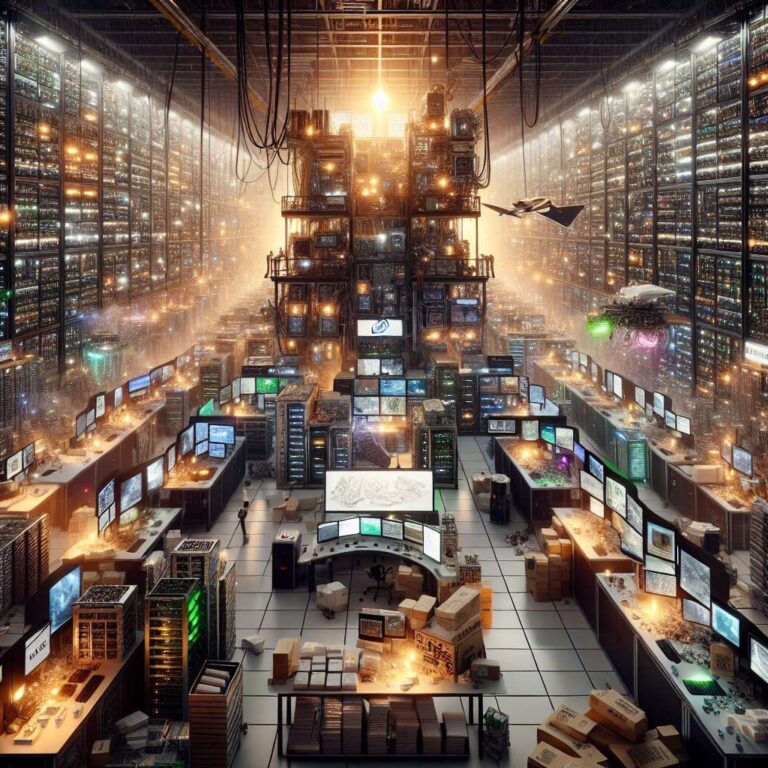
Chip vendors, cloud platforms, and hyperscalers are rapidly expanding data center chip portfolios as artificial intelligence workloads drive unprecedented compute demand. New partnerships such as Gimlet Labs and d-Matrix focus on pairing specialized inference accelerators with GPUs to boost performance and power efficiency for frontier artificial intelligence workloads. Intel is broadening its edge artificial intelligence footprint with the launch of the Core Series 2 processor, while Broadcom is pursuing a diversified silicon strategy anchored by a $100B artificial intelligence chip investment. Major cloud operators are also scaling up, with Akamai adding “thousands” of Nvidia Blackwell GPUs to enhance inference, and South Korea planning to expand artificial intelligence infrastructure with 260,000 Nvidia chips.
Hyperscalers and large internet platforms are intensifying efforts to control more of their silicon stacks. Meta plans to develop custom chips to train its artificial intelligence models, and AMD and Meta have struck a $100B, 6 GW chip deal as the artificial intelligence race accelerates. Microsoft is deploying multiple custom designs, including the Cobalt 200 chip to expand the Azure artificial intelligence platform and the Maia 200 inference chip to handle specialized workloads. AWS is pressing its advantage with the launch of the Trainium3 chip to challenge Nvidia’s artificial intelligence dominance, while Project Rainer brings together AWS and Anthropic in a massive artificial intelligence supercomputing cluster. Qualcomm is moving into the data center artificial intelligence chip market to challenge Nvidia and AMD, and Nvidia is pushing further with the Rubin platform and new Instinct GPU competition from AMD targeting data centers.
Market dynamics and geopolitics are reshaping the competitive landscape for advanced processors. Wall Street’s reaction to Nvidia’s record earnings underscores concerns about an artificial intelligence market bubble, even as Nvidia’s upbeat forecast seeks to calm those fears. Trade tensions and export controls are influencing supply routes and customer access, with artificial intelligence chip export controls emerging as a new challenge for data center operators and the US approving some Nvidia UAE sales in a Trump artificial intelligence diplomacy step. At the same time, low latency and power are becoming strategic differentiators, as illustrated by new “artificial intelligence pods” bringing low-latency compute to smaller US cities and analyses of how the shift from MW to GW is forcing a complete rethink of data center power. Security and reliability pressures are increasing, with research highlighting that a cheap hardware module bypasses AMD and Intel memory encryption and drone strikes on AWS data centers triggering outages that raise concerns about cloud resilience.