
Composable and sovereign artificial intelligence aims to move enterprises beyond pilots

Enterprises are shifting toward composable and sovereign artificial intelligence architectures to overcome infrastructure bottlenecks that keep most pilots from delivering business value at scale.

Today marks an inflection point for enterprise artificial intelligence adoption, as organizations confront the gap between successful proofs of concept and the struggle to achieve production-grade deployments. The article notes that despite billions invested in generative artificial intelligence, only 5% of integrated pilots deliver measurable business value and nearly one in two companies abandons artificial intelligence initiatives before reaching production. The problem is framed not as a failure of models, but as a failure to translate controlled experiments into robust, scalable systems that can operate in complex enterprise environments.

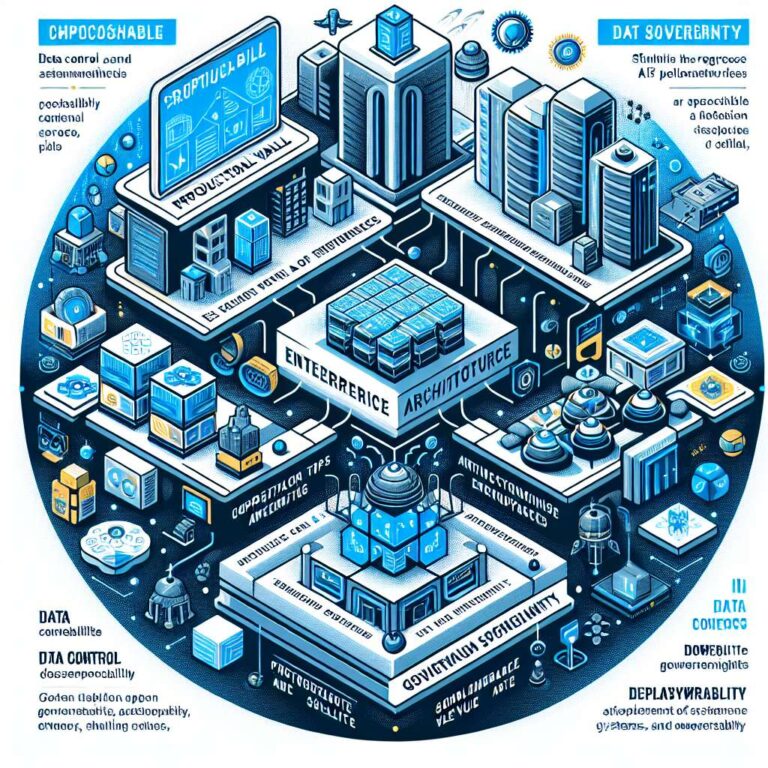
The core bottleneck is identified as the surrounding infrastructure rather than the underlying large language models or retrieval augmented generation techniques themselves. Limited data accessibility, rigid integration approaches, and fragile deployment pathways are described as key blockers that prevent artificial intelligence initiatives from scaling beyond early LLM and RAG experiments. In response to these constraints, the article explains that enterprises are moving toward composable and sovereign artificial intelligence architectures that can lower costs, preserve data ownership, and keep pace with the rapid, unpredictable evolution of artificial intelligence technologies, a shift that IDC expects 75% of global businesses to make by 2027.

The piece highlights a structural disconnect between how proofs of concept are run and how production systems must operate. Artificial intelligence pilots almost always work because they “live inside a safe bubble,” as Cristopher Kuehl, chief data officer at Continent 8 Technologies, points out, with carefully curated data, minimal integrations, and work handled by highly motivated senior teams. Gerry Murray, research director at IDC, argues that the issue is less about pilot failure and more about structural mis-design, with many artificial intelligence initiatives effectively “set up for failure from the start.” The overall message is that enterprises must rethink architectures and operating conditions to move beyond isolated pilots and realize durable business value from artificial intelligence in production.
55

Impact Score

OpenClaw pushes autonomous Artificial Intelligence agents into enterprises

OpenClaw’s rapid growth is accelerating interest in persistent, self-hosted autonomous agents that run continuously instead of waiting for prompts. NVIDIA is positioning NemoClaw as a more secure reference implementation for organizations that want local control, auditability and hardened deployment defaults.

Indiana launches Artificial Intelligence business portal

Indiana is rolling out IN AI, a statewide portal meant to help employers adopt Artificial Intelligence with practical guidance, workshops and peer support. State leaders and business groups are positioning the effort as a way to raise productivity, wages and job growth while keeping workers at the center.

Goodfire launches model debugging tool for large language models

Goodfire has introduced Silico, a mechanistic interpretability platform designed to let developers inspect and adjust model behavior during development. The company is positioning it as a way to give smaller teams deeper control over open-source models and more trustworthy outputs.

Nvidia launches nemotron 3 nano omni for enterprise agents

Nvidia has introduced Nemotron 3 Nano Omni, a multimodal open model designed to support enterprise agents that reason across vision, speech and language. The launch extends Nvidia’s push beyond hardware into models and services while targeting more efficient agentic workflows.

Intel 18A-P node improves performance and efficiency

Intel plans to present new results for its 18A-P process at the VLSI 2026 Symposium, highlighting gains in performance, power efficiency, and manufacturing predictability. The updated node is positioned as a stronger option for customers seeking 18A density with better operating characteristics.

Contact Us

Got questions? Use the form to contact us.

Contact Form

Clicking next sends a verification code to your email. After verifying, you can enter your message.