Today marks an inflection point for enterprise artificial intelligence adoption, as organizations confront the gap between successful proofs of concept and the struggle to achieve production-grade deployments. The article notes that despite billions invested in generative artificial intelligence, only 5% of integrated pilots deliver measurable business value and nearly one in two companies abandons artificial intelligence initiatives before reaching production. The problem is framed not as a failure of models, but as a failure to translate controlled experiments into robust, scalable systems that can operate in complex enterprise environments.
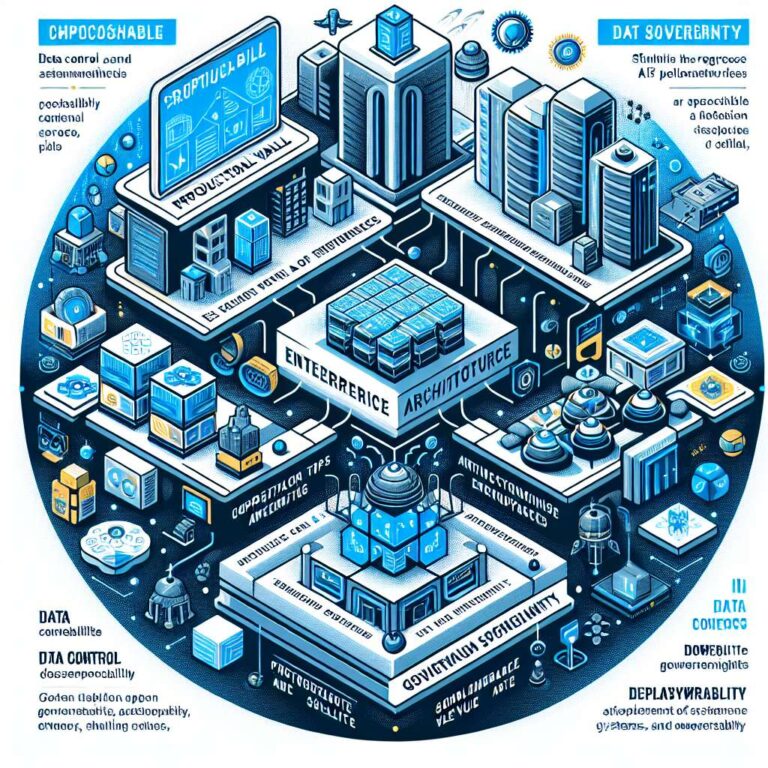
The core bottleneck is identified as the surrounding infrastructure rather than the underlying large language models or retrieval augmented generation techniques themselves. Limited data accessibility, rigid integration approaches, and fragile deployment pathways are described as key blockers that prevent artificial intelligence initiatives from scaling beyond early LLM and RAG experiments. In response to these constraints, the article explains that enterprises are moving toward composable and sovereign artificial intelligence architectures that can lower costs, preserve data ownership, and keep pace with the rapid, unpredictable evolution of artificial intelligence technologies, a shift that IDC expects 75% of global businesses to make by 2027.
The piece highlights a structural disconnect between how proofs of concept are run and how production systems must operate. Artificial intelligence pilots almost always work because they “live inside a safe bubble,” as Cristopher Kuehl, chief data officer at Continent 8 Technologies, points out, with carefully curated data, minimal integrations, and work handled by highly motivated senior teams. Gerry Murray, research director at IDC, argues that the issue is less about pilot failure and more about structural mis-design, with many artificial intelligence initiatives effectively “set up for failure from the start.” The overall message is that enterprises must rethink architectures and operating conditions to move beyond isolated pilots and realize durable business value from artificial intelligence in production.