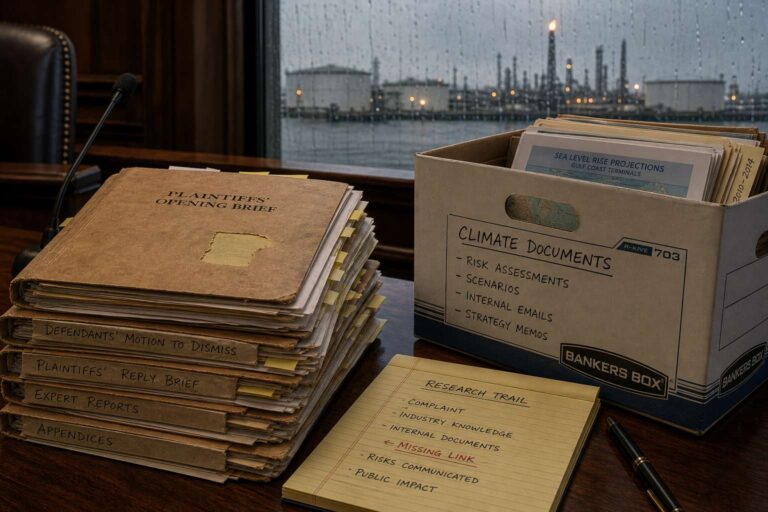
A climate lawsuit over an aging petroleum storage terminal in Connecticut has become an early test of how courts may handle generative Artificial Intelligence in expert testimony. A federal judge agreed to stay a May order requiring the Boston-based Conservation Law Foundation to provide Shell with details of a search used by one of its expert witnesses. CLF argued that the order would force it to disclose material that does not exist, specifically the Artificial Intelligence prompts used by the expert to narrow research.
Shell has until June 10 to offer a response. Judge Vernon Oliver of the U.S. District Court for the District of Connecticut will then decide whether to keep the stay in place while reviewing the magistrate judge’s order, and later whether to uphold or vacate it. CLF filed its lawsuit against Shell in 2021, accusing the oil giant of failing to ready petroleum storage terminals in New Haven, Connecticut, for climate-change-induced flooding and severe storms. The case has dragged on for years, with a judge in 2023 denying the company’s bid to dismiss the lawsuit and urging the parties to reach a negotiated settlement.
The latest dispute arose after Shell sought materials, including Artificial Intelligence prompts and queries, used by Naomi Oreskes, a Harvard professor and CLF expert who has studied climate disinformation. Shell argued that if Oreskes used Artificial Intelligence to narrow the scope of documents she planned to review, the prompts should be treated as part of her workflow and produced for cross-examination. The company said the refusal raised concerns about its ability to assess how the data affected her opinions or whether Artificial Intelligence hallucinated and produced misleading or inaccurate information.
Magistrate Judge Thomas Farrish ruled in May that Shell could see the prompts because an expert witness’s methodology is fair ground for discovery. Attorneys focused on cyber and data issues said the decision is notable because it treats Artificial Intelligence prompts as a data source that may be discoverable when used by an expert. CLF said prompts were used only to cull a large document universe and were never considered by Oreskes in forming her opinions. It also said no data logs preserving the prompts exist, while Farrish warned that sanctions may be available if that representation later proves untrue.