During the week of May 28 to June 4, 2026, the Artificial Intelligence stack shifted across coding tools, inference hardware and agent protocols. Anthropic released Claude Opus 4.8 on May 28, 2026, and paired it with Dynamic Workflows for Claude Code, giving the terminal agent a way to plan and run multi-step tasks with less developer hand-holding. A JetBrains survey of engineers with more than ten years of experience found that 46% picked Claude Code as their daily tool, against 9% for GitHub Copilot. Cursor’s revenue moved from 100 million dollars in annual recurring revenue in January 2025 to 1 billion by mid-2025, underscoring the momentum behind tools designed around agents from the start.
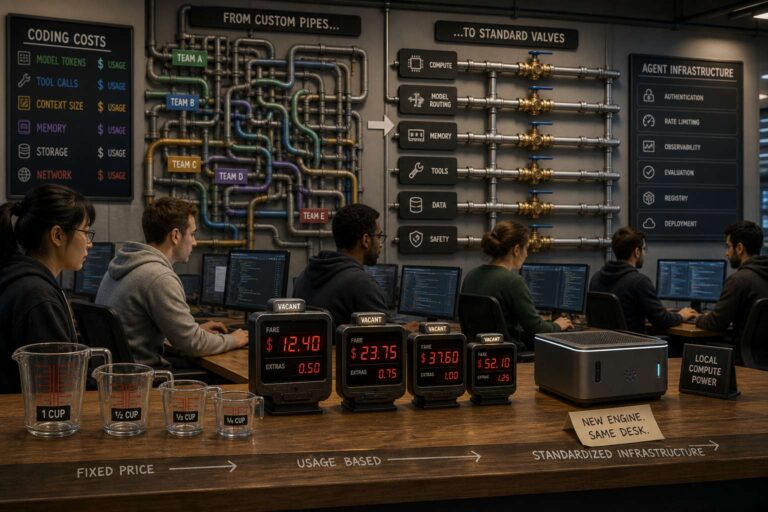
GitHub Copilot moved to usage-based billing on June 1, 2026, replacing flat unlimited agent use with Artificial Intelligence Credits. Copilot Pro at 10 dollars a month now buys a 1,500-credit monthly allowance instead of unlimited agent use, and GitHub also added a 100 dollar Max plan for developers who run agents all day. A Q1 2026 survey cited in one buyer guide found that 42% of developers ranked cost volatility as their top pain point, ahead of model reliability. Security also moved closer to the coding assistant layer, with Salt Security launching Salt Code on June 2, 2026. Roughly 48% of Artificial Intelligence-generated code carries a security flaw, and about 75% of senior developers still review every snippet before merging.
NVIDIA CEO Jensen Huang presented the RTX Spark Superchip at Computex 2026 in Taipei on June 1, positioning it as an Arm-based system-on-chip for Windows PCs. Shares of AMD, Intel, and Qualcomm fell after the announcement as NVIDIA extended its ambitions from the data center into edge devices. CPUs have run on the x86 instruction set that Intel pioneered in the 1970s and AMD extended later. Arm’s lower-power design went mainstream when Apple put it in the first iPhone in 2007, and Amazon brought it to the data center with Graviton in 2018. On-device inference promises lower latency, stronger privacy and reduced cloud GPU costs for workloads such as local coding agents and document search.
The Model Context Protocol also moved toward a more scalable foundation. The MCP maintainers published the 2026-07-28 specification release candidate on May 21, 2026, and the final specification ships on July 28, 2026. The new design makes MCP stateless at the protocol layer, allowing remote servers to run behind ordinary round-robin load balancers instead of relying on sticky sessions and shared session stores. As of March 2026, MCP passed 97 million monthly SDK downloads and 81,000 GitHub stars, with support from Anthropic, OpenAI, Google, Microsoft, and AWS. A2A marked its one-year milestone with more than 150 supporting organizations, giving teams a complementary standard for agent-to-agent communication while MCP handles tool and data access.