At this year’s CES in Las Vegas, Chinese technology companies made an unusually strong showing, highlighting how central they have become to global consumer electronics and artificial intelligence. The event, which is described as the world’s biggest tech show and happens every January, attracted over 148,000 attendees and over 4,100 exhibitors, and nearly a quarter of all companies at the show came from China. Seasoned attendees said this was the first post-covid CES where China’s presence was impossible to miss, with large numbers of industry professionals and investors from China converging on the show, often citing artificial intelligence as both the reason and justification for the trip.
Artificial Intelligence was the dominant theme across the convention, with “We added AI” used as a marketing hook on a wide range of products, from PCs and phones to slippers and bed frames. Many consumer artificial intelligence gadgets still felt early and inconsistent in quality, but educational tools and emotional support toys stood out, reflecting a booming category in China. Examples included Luka AI’s robotic panda that monitors babies and Fuzozo’s keychain-size artificial intelligence pet that reacts to user behavior, even as privacy questions linger. Chinese firms also appeared to lead in household electronics, shipping increasingly sophisticated home robots, cameras, security systems, drones, lawn equipment, and cleaning appliances that quietly dominate Western markets while defying old stereotypes of Chinese products as merely cheap or repetitive.
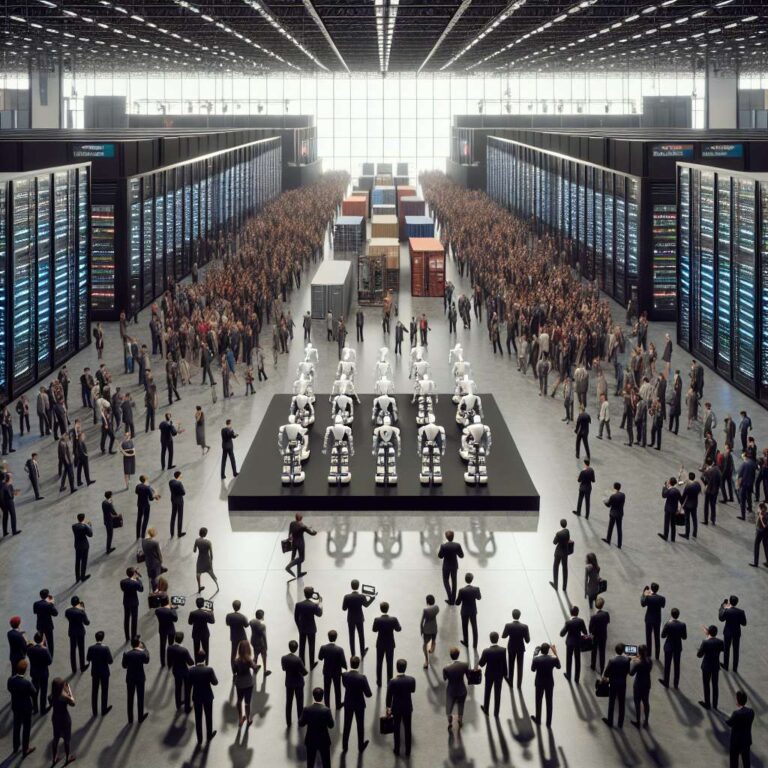
Humanoid robots became one of the most visible crowd-pleasers, with Chinese companies staging elaborate demos of dancing, boxing, and dexterous tasks like folding paper, doing laundry, playing piano, and making latte art. Many of these robots remained one-trick systems optimized for specific staged tasks and could quickly become confused when those tasks were altered. Even so, they are treated as an important next frontier because they can help pull artificial intelligence beyond text interfaces into the physical world, especially as large language models and vision-language models mature. The article notes that there is far less physical-world data than text data to train artificial intelligence, positioning humanoid robots as both applications and roaming data collectors, an area where China can leverage its strengths in supply chains, manufacturing, and related sectors like electric vehicles, batteries, motors, and sensors.
Beyond flashy gadgets, Chinese companies were active across the entire technology stack, from end products to frameworks, tools, internet of things infrastructure, and spatial data. Open-source practices appeared deeply ingrained, with engineers from Hangzhou, described as China’s “little Silicon Valley,” talking about artificial intelligence hackathons happening every week in the city. The article states that the headline innovations at CES 2026 were not in devices but in cloud offerings, including platforms, ecosystems, enterprise deployments, and “hybrid AI” that marries cloud and on-device processing. Lenovo hosted some of the most talked-about main-stage events, focusing not just on PCs but on its cross-device artificial intelligence agent system, Qira, and a partnership pitch with Nvidia for artificial intelligence cloud providers. Nvidia’s CEO, Jensen Huang, introduced Vera Rubin, described as a new data-center platform that would dramatically lower costs for training and running artificial intelligence, while AMD’s CEO, Lisa Su, unveiled Helios, another data-center system designed for large artificial intelligence workloads, underscoring how data centers are racing to keep services powerful and affordable.
Throughout the show, Chinese founders and investors conveyed a sense of cautious optimism. At informal gatherings, VCs and entrepreneurs from China mixed comfortably with Bay Area transplants, and the prevailing attitude was that manufacturing at scale enables faster innovation and iteration than in the West. Rather than focusing on extracting revenue from domestic consumers, many Chinese firms now default to a strategy of building in China, selling globally, and treating the US market as a proving ground, suggesting a more outward-looking and confident phase for China’s artificial intelligence and hardware ecosystem.