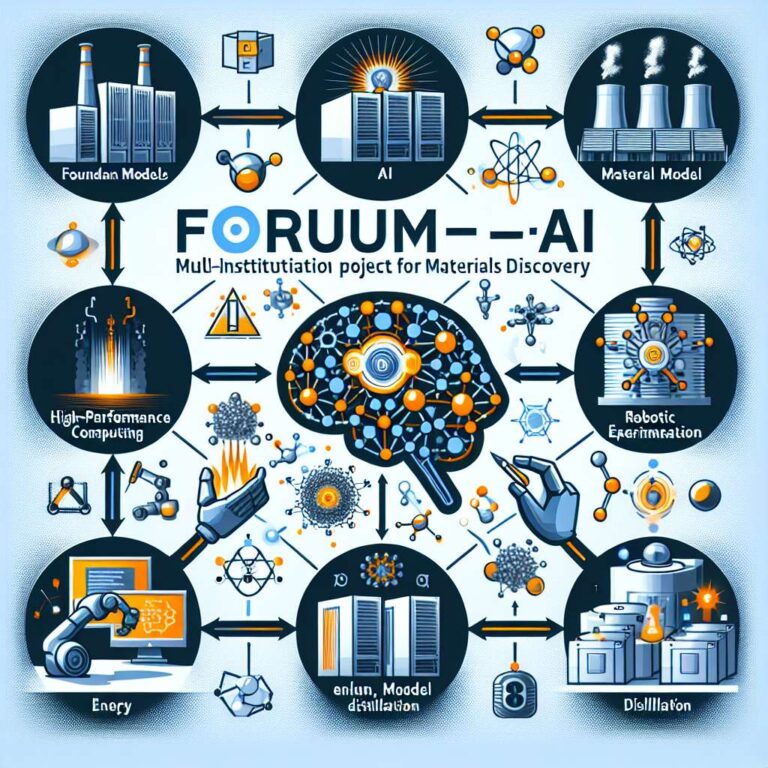
Lawrence Berkeley National Laboratory is leading a new multi-institutional project to create an Artificial Intelligence assistant that accelerates the discovery of materials for batteries, semiconductors, and other energy technologies. The initiative, called FORUM-AI (Foundation Models Orchestrating Reasoning Agents to Uncover Materials Advances and Insights), supports the Department of Energy’s Genesis Mission to advance Artificial Intelligence for challenges in science, energy, and national security. Principal investigator Anubhav Jain describes FORUM-AI as a “first full-stack, agentic Artificial Intelligence system for materials science research and discovery” that will support researchers from hypothesis generation and computer simulations through laboratory experiments and analysis.
The collaboration brings together Berkeley Lab, Oak Ridge National Laboratory, Argonne National Laboratory, the Massachusetts Institute of Technology, and The Ohio State University to build an open-source, general-purpose Artificial Intelligence platform for materials and the physical sciences. The team was selected under the Department of Energy’s Scientific Discovery through Advanced Computing program to co-lead the four-year, $10 million project, which will rely on some of the nation’s most advanced high-performance computing resources. FORUM-AI is designed to move beyond traditional, one-hypothesis-at-a-time research by using leadership-class supercomputers at facilities such as NERSC, OLCF, and ALCF to evaluate hundreds of hypotheses and research plans in parallel, and by potentially executing robotic experiments to test the most promising directions.
The assistant will integrate three classes of Artificial Intelligence: generative models to create images and text, reasoning models that carry out internal thought processes and propose solution strategies, and agentic models that take actions such as running simulations or controlling experimental facilities. To ensure factual reliability and address hallucinations, the system will rely on high-quality, verified materials databases, provide transparent and inspectable research plans and reasoning traces, and use standard physics-based simulation tools that are well benchmarked by the community. The project will also explore model distillation so that smaller, less energy-intensive models can reproduce the behavior of larger ones and run on laptops or be attached directly to instruments like X-ray diffraction machines, improving accessibility and energy efficiency.
National laboratories are described as essential venues for this work because of longstanding investments in materials data infrastructure, automated simulation software, robotic synthesis facilities such as Berkeley Lab’s A-Lab, and access to some of the world’s fastest supercomputers. By the end of the project, the team aims to deliver an end-to-end autonomous platform that can propose compositionally complex materials to meet property targets, coordinate synthesis at robotic labs, analyze experimental data, and autonomously plan successive rounds of experiments. Looking ahead, the researchers envision linking FORUM-AI to experimental user facilities such as light sources so that agentic Artificial Intelligence systems can prepare or assist with experiments before and during user visits. The long-term goal is for FORUM-AI to become an indispensable partner in the national scientific enterprise and significantly accelerate materials discoveries that support future energy needs.