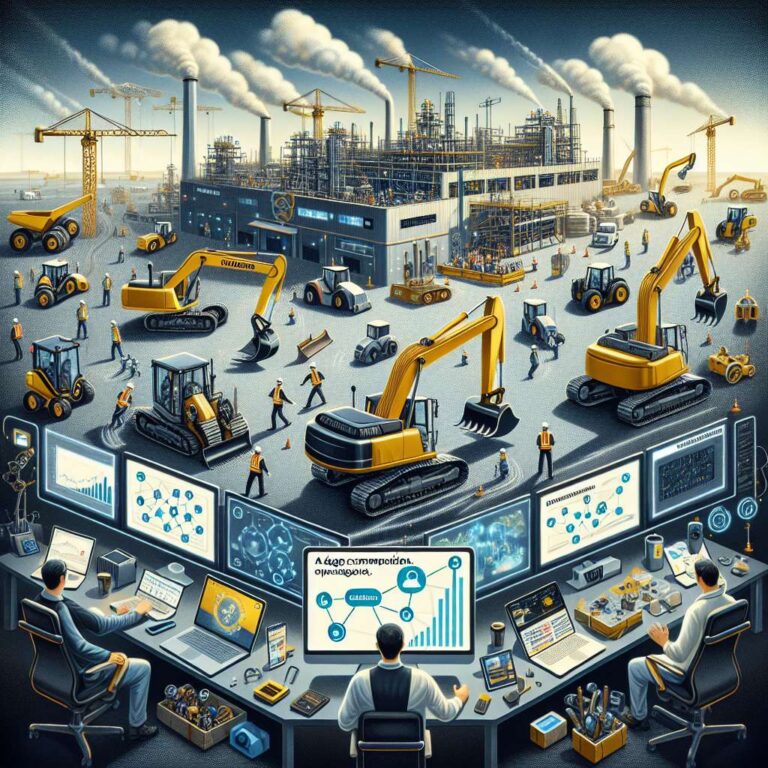
Heavy construction equipment is emerging as a prime target for industrial automation as four forces converge in 2026: a worsening labor shortage, the migration of veteran autonomous vehicle talent into heavy industry, major advances in hardware, and a growing premium on industry-specific domain knowledge. Tasks such as bulldozing, earthmoving and loading are repetitive, hazardous and central to infrastructure buildout, which makes the case for autonomy compelling after years of being overshadowed by self-driving cars. Companies like AIM Intelligent Machines, founded by former Google artificial intelligence researcher Adam Sadilek, are retrofitting fleets so operators can shift from sitting in cabs to supervising mixed fleets of robotic machines, with the goal of multiplying output while reducing exposure to dangerous environments rather than replacing scarce workers.
Economic and safety pressures are sharpening the need to augment human operators. Total US construction spending has increased nearly 50% in the last five years, reaching roughly $2.2 trillion in 2025, with manufacturing facilities alone accounting for 17% of the growth in construction spending over that period, up from 5% in the 2010s. At the same time, the Associated Builders and Contractors estimates that 349,000 more construction workers are needed to meet project demand in 2026 and 456,000 new workers are needed by 2027, while total employment of construction equipment operators increased just 14% from 2019 to 2024. Construction and extraction workers account for 20% of annual workplace deaths in the US, contact-related accidents including heavy equipment mishaps cause about 800 deaths and thousands of injuries per year, and excavators rank among the leading causes of fatal accidents in construction, underscoring the safety imperative to remove people from high-risk zones and put them in fleet management roles.
Venture capital and talent that once focused on passenger autonomous vehicles are increasingly targeting industrial use cases and embodied intelligence. US venture capital investment in construction-related technologies surpassed $2.6 billion in 2025, a record high and a 63% increase from the prior year, while founders from Waymo, SpaceX, Cruise and Tesla are launching startups that retrofit existing equipment and build foundational robotic models. Bedrock Robotics, founded by former Waymo engineers, raised $260 million in February 2025 to robotically retrofit construction equipment, and companies like FieldAI, which has raised over $500 million, are developing embodied artificial intelligence systems that act as robot brains for three-dimensional environments. Total VC investment in companies developing foundational robotic models reached $4.8 billion over the last four quarters, as researchers and investors conclude that language-only models are insufficient for safe operation in the physical world.
Hardware and compute advances are making this shift technically and economically viable. Early autonomous vehicles in the mid-2010s relied on LiDAR that cost $75K or more, but today advanced LiDAR systems sell for under $1K, while ruggedized cameras and commoditized sensors can be swapped between machines rather than custom-engineered into each vehicle. On the compute side, specialized edge chips are enabling real-time planning and safety decisions on the machine instead of relying on unreliable job site connectivity. NVIDIA’s Jetson Thor chip, released in 2025, can deliver roughly two quadrillion tera floating point operations per second of artificial intelligence compute, which is a 7.5x increase in performance over the previous generation of chips released just two years prior, and Caterpillar has already announced a collaboration with the Jetson Thor platform to power on-site intelligence in its construction, mining and power equipment.
Domain expertise and integration with incumbent ecosystems are emerging as decisive advantages as industrial artificial intelligence moves from pilots to production. Heavy equipment manufacturers such as Caterpillar are embedding autonomy into excavators, bulldozers, loaders and haulers, and are introducing in-cab artificial intelligence assistants to coach operators, which makes it easier to progress toward full autonomy. Rather than displacing incumbents, startups are partnering with original equipment manufacturers and dealer networks, often white labeling technology and deploying teams on-site for weeks to train operators and retrofit fleets. Trimble illustrates the power of deeply integrated workflow platforms, having amassed $2.4 billion in ARR (out of $3.6 billion total revenue) from connected construction software and geospatial tools that future embodied artificial intelligence systems must plug into. As perception, control and fleet-management capabilities consolidate into unified platforms through acquisitions and corporate venture investment, heavy industry is becoming a critical proving ground for human-machine collaboration, edge intelligence and real-world learning beyond 2026.