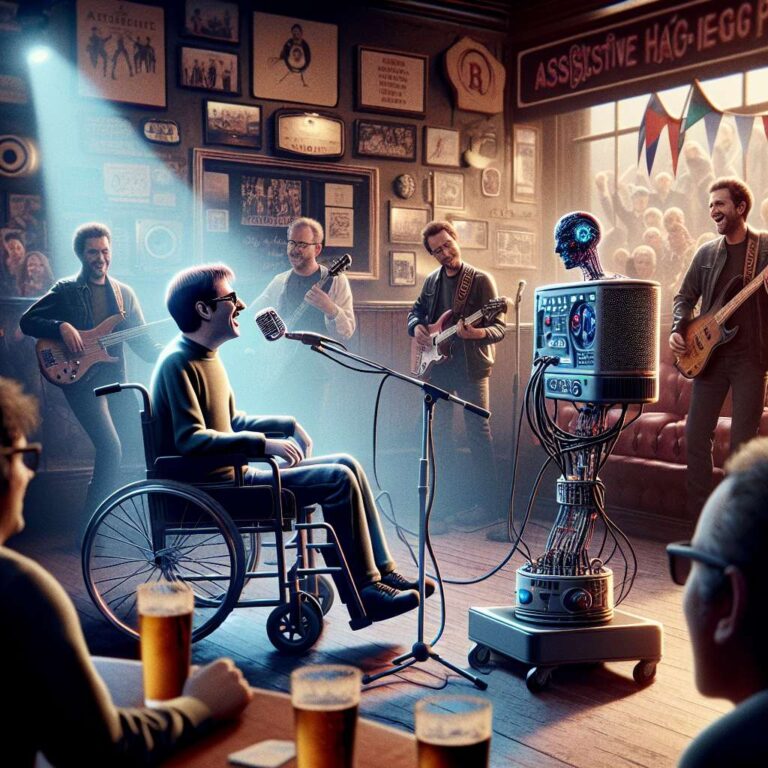
Musician and composer Patrick Darling returned to the stage in London with his bandmates, two years after amyotrophic lateral sclerosis (ALS) robbed him of the ability to sing and perform. Diagnosed at 29 years old, the now 32-year-old had gradually lost control of his legs, hands, and eventually his voice, leading to his final pre-diagnosis performance in June 2024. The London event marked an emotional comeback as a heartfelt song he wrote for his great-grandfather played, featuring a re-created version of his own voice generated by Artificial Intelligence.
Darling had been a multi-instrumentalist since around 14 years old, playing bass guitar, acoustic guitar, piano, melodica, mandolin, and tenor banjo, but described singing as his greatest love. His decline became visible to bandmate Nick Cocking when Darling began frequently slipping and falling, and later needed to sit during performances in August 2023 as his legs weakened. By April 2024, he was struggling to talk and breathe at the same time, and after being carried on stage for a performance, he told Cocking the next day that he could not continue, bringing their time as an active band to a close.
A speech therapist initially suggested conventional voice banking, where people record speech to be used in text-to-speech tools, but Darling felt his altered voice meant he was preserving “the wrong voice.” He was then introduced to speech and language therapist Richard Cave, a researcher at University College London and consultant for Artificial Intelligence audio company ElevenLabs. ElevenLabs runs an impact program offering free licenses to its voice cloning tools for people who have lost their voices to ALS and other conditions such as head and neck cancer or stroke. Using older recordings, Cave and Darling generated a “voice clone” that Darling said sounded exactly like he had before, close enough that he felt listeners would not be able to tell the difference.
Re-creating Darling’s singing voice required more effort because the cloning tool typically requires around 10 minutes of clear audio, and he had no high quality vocal recordings. Cave instead sourced audio from phone videos taken in noisy pubs and a few kitchen recordings, which were enough to build what Cave described as a “synthetic version of [Darling’s] singing voice” that carried the same rasp and imperfections as the originals. ElevenLabs also developed an Artificial Intelligence music generator called Eleven Music, which can generate a song in a minute and supports 74 languages. While the system lets users create music and lyrics in any style using text prompts, Cave and Darling spent around six weeks fine-tuning the track, reflecting Darling’s preference for Irish folk and drawing on Cave’s experience helping another user in Colombia create Colombian folk music.
Once the track was finished, Cave shared it with Cocking, who said he was overwhelmed with emotion and needed several attempts to listen to the entire song. Darling and Cave arranged to present the track live at the ElevenLabs summit in London on Wednesday, February 11, with Cocking and bandmate Hari Ma composing new mandolin and fiddle parts and rehearsing for a couple of weeks beforehand. At the summit, Cave wheeled Darling onto the stage as the song played, while Cocking and Ma performed live alongside the Artificial Intelligence generated vocal. Cocking and Cave say Darling intends to keep using these tools to compose and record music, and Cocking hopes they will perform together again, even as the progression of ALS makes future plans uncertain. For both men, the performance was a bittersweet but joyful proof that technology can restore a sense of identity, creativity, and pride to someone whose physical voice has been taken away.