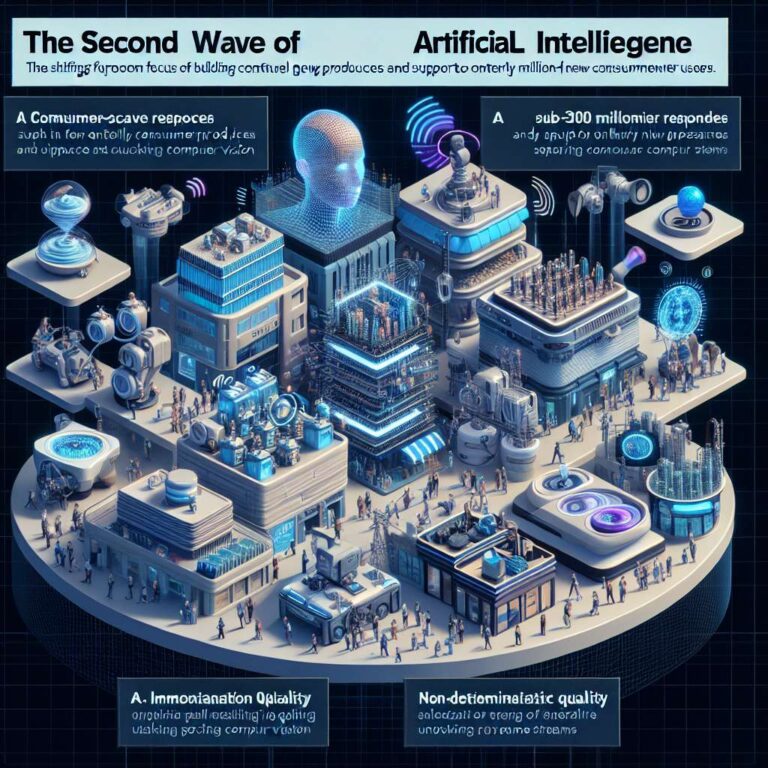
A growing group of founders and investors is pushing for a “Second Wave” of Artificial Intelligence, defined less by automation and cost cutting and more by entirely new consumer products. Inworld CEO Kylan Gibbs argues that the “first wave of AI made existing things cheaper” while the next wave focuses on “new products, new experiences, new revenue,” expanding the overall economic pie instead of only trimming expenses. Gibbs says Artificial Intelligence reaches its real economic potential when it generates value that consumers will pay for, and he calls for a “consumer-scale AI stack” that can deliver real-time responses under 300 milliseconds, support millions of users simultaneously, and power deeply personalized experiences.
To catalyze this shift, Gibbs launched a Silicon Valley accelerator in January to back up to 30 “Second Wave” Artificial Intelligence startups building native consumer experiences rather than bolt-on chatbots. Venture capital firms including Khosla Ventures and Lightspeed Venture Partners are participating, alongside leaders from OpenAI, Google, and Stripe, with a demo day set for early March in San Francisco. The approach aligns with Y Combinator CEO Garry Tan’s call for founders to pursue products that were not previously imaginable, rather than simply delivering existing services more cheaply.
Several early-stage companies illustrate how this second wave is taking shape across sectors. Particle, led by CEO Sara Beykpour, is an Artificial Intelligence native news platform where work that once required a month can now be built, tested, and deployed in hours, freeing the team to experiment with novel formats. The company’s Podcast Clips feature embeds the most relevant snippets of long-form podcasts directly into news stories, using Artificial Intelligence embeddings to link segments such as a talk show about Greenland and Davos, with comments from President Donald Trump, to related reporting, while generative Artificial Intelligence adds summaries and context. In fitness, Luvu, launched in August 2025 by CEO Alexis Sursock and CTO Creston Brooks, has attracted about 250,000 users to an app where an Artificial Intelligence “marshmallow” personal trainer sends highly tailored notifications and real-time feedback, helping the company achieve notification click rates four times higher than typical non-personalized prompts and retention rates that are two to three times better in an industry where only 2% to 3% of users stay active after 30 days.
Luvu offers three motivational styles, from supportive to a “meaner marshmallow,” and uses large language models to craft granular one-to-one messages, while also testing reinforcement learning with verified rewards. Users record their workouts so computer-vision models can verify movements and provide real-time corrections such as “Straighten your knees,” creating a feedback loop between human behavior and Artificial Intelligence that was not feasible before modern models. In gaming, Status, an Artificial Intelligence powered social simulation app from CEO Fai Nur, has surpassed 3 million downloads by letting users role-play in Artificial Intelligence generated social media worlds resembling a living social feed, where players can inhabit roles such as Hogwarts students or soccer stars and receive instant, dynamic responses from Artificial Intelligence characters. The non-deterministic nature of large language model outputs, often seen as a liability in enterprise settings, becomes an asset in Status because each new response can be different and enrich the game world.
Across these examples, proponents of Artificial Intelligence’s Second Wave contend that the technology’s future lies in products that feel native to Artificial Intelligence and offer surprising, personalized, and interactive experiences at consumer scale. Where the first wave focused on making businesses leaner, this emerging phase aims to make everyday life more immersive, motivational, and entertaining, while creating new categories of apps, games, companions, and services that consumers are willing to pay for.