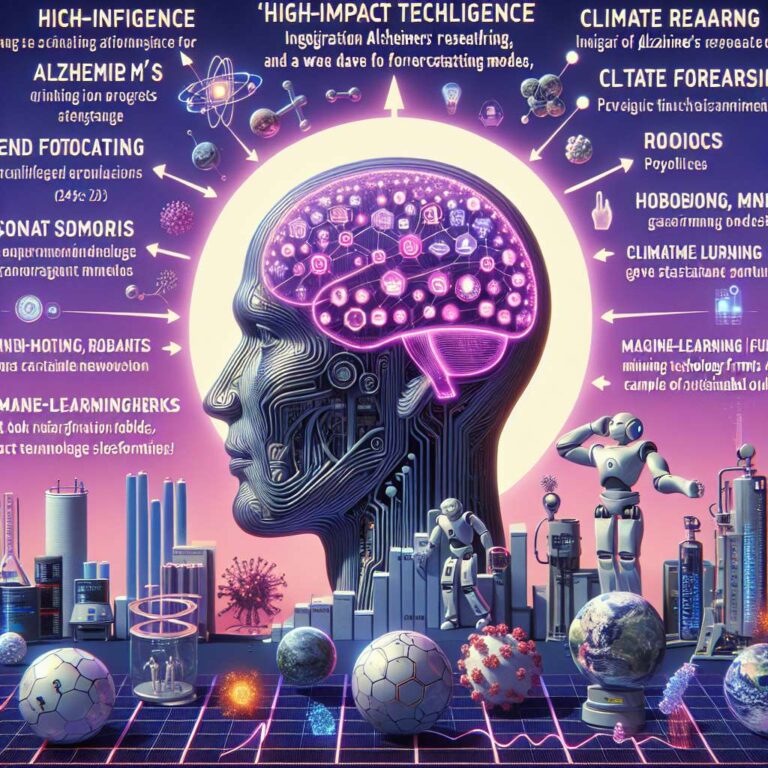
Artificial Intelligence-driven scientific innovation accelerated in 2025, transforming how experiments are designed and how results are analyzed across fields such as health care, robotics, climate science, and materials research. Much of this momentum came from the private sector, where companies built and deployed powerful new models and computing tools that are now influencing the direction of scientific discovery. These advances are also reshaping institutional power, placing technology firms at the center of what some observers describe as a new scientific revolution.
In medicine, researchers at a wide range of universities and health care institutions reported progress toward faster and cheaper diagnoses for Alzheimer’s and related diseases, with Artificial Intelligence systems aiding both primary care detection and future therapies. One study found that a specific gene is a cause of Alzheimer’s, and the researchers said they were only able to make this discovery because Artificial Intelligence helped them visualize the three-dimensional structure of the protein. Google released its AlphaGenome model to understand diseases better and lead to drug discovery, enabled by technical advancements that allow it to process long DNA sequences and provide quality predictions.
Robotics and climate science also saw major leaps as researchers and companies combined generative Artificial Intelligence with physical capabilities and physics-based models. Advancements in humanoid robots’ dexterity and human interaction led some to predict that Artificial Intelligence-enabled robots could eventually clean homes, provide companionship, work in warehouses, or assist in health care settings, even as general-purpose humanoids remain a longer-term goal. Weather forecasting became more powerful as researchers combined Artificial Intelligence with physics-based climate models to predict extreme “gray swan” events that may happen every 1,000 years, and Google released its most advanced forecasting model, which can generate forecasts eight times faster than before.
Materials science benefitted from high demand for low-emission, cost-effective cement alternatives, prompting an MIT team to use Artificial Intelligence to identify new concrete ingredients. A machine-learning framework helped the team analyze scientific literature and more than one million rock samples to narrow down viable alternatives. These achievements built on years of corporate Artificial Intelligence investment, particularly at Google, whose DeepMind unit previously produced AlphaFold2, which predicts a protein’s 3D structure and contributed to a Nobel-winning breakthrough five years ago. Google-affiliated scientists have now been associated with six Nobel Prizes, including three in the last two years.
The surge in capability is fueling a new ecosystem of science-focused startups. Lila Sciences has declared a mission to “build scientific superintelligence,” saying it uses specialized Artificial Intelligence software to generate and direct experiments in real-world labs, backed by major venture capital firms. Latent Labs recently announced a frontier model that it says can help design drugs and accelerate pharmaceutical development timelines by reducing wet lab work. Public funding is rising as well: The federal government invested 3.3 billion in non-defense Artificial Intelligence research and development in fiscal year 2025, according to a report by the Center for Strategic and International Studies, while private sector investments exceeded 109 billion in 2024.
In Washington, President Trump is moving to shape the trajectory of Artificial Intelligence-driven science policy. An executive order signed last month created “the Genesis Mission,” an initiative intended to coordinate research efforts across federal agencies. Two dozen leading Artificial Intelligence companies, including Microsoft, Nvidia, and Google, have joined the effort, signaling a tighter partnership between government and industry. The administration is reportedly looking to accelerate robotics next year as well, underscoring how Artificial Intelligence-enabled systems and automation are becoming central to national science and technology strategy.