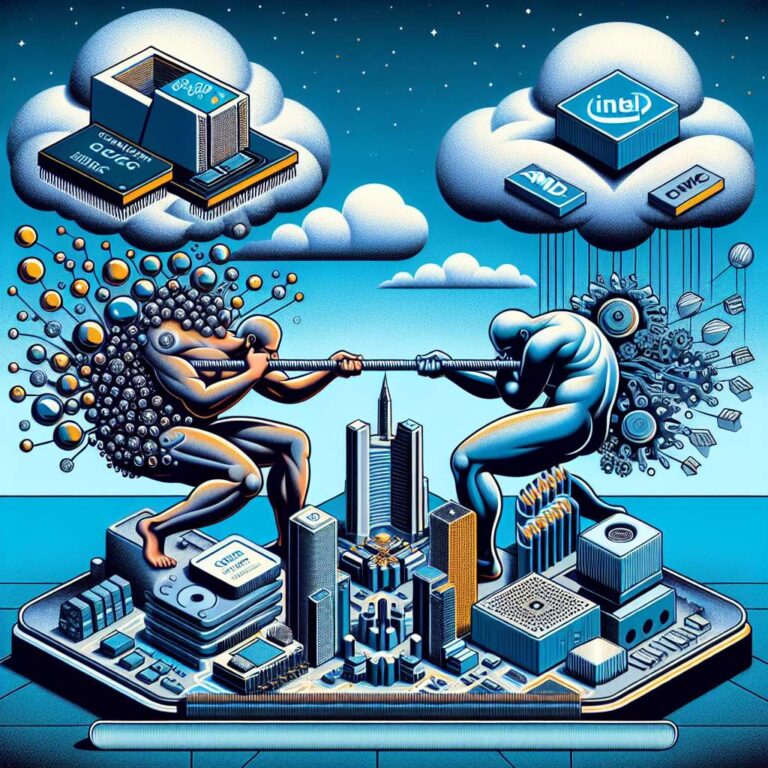
Artificial Intelligence is evolving from experimental applications to industrial-scale deployment, and the article frames that shift as an infrastructure story centered on semiconductors and cloud compute. Demand for specialized chips and hyperscale data center capacity is presented as a durable, multi-year trend that changes how investors should view hardware, foundries and cloud providers.
On the semiconductor side, the piece highlights the AI semiconductor market as a major growth engine, citing a market valued at $123.16 billion in 2024 and projected to reach $311.58 billion by 2029. NVIDIA is described as the dominant player, controlling 80% of the AI accelerator market with H100 GPUs sold between $25,000 and $40,000 per unit, and reporting a 279% year-over-year surge in data center revenue to $18.4 billion in Q3 2023. Competitive dynamics include AMD’s MI300X, noted for 192GB of HBM3 memory for large workloads, and Intel’s Gaudi efforts targeting cost-sensitive customers. TSMC’s expansion of advanced packaging like CoWoS and a 28% share in Foundry 2.0 in 2023 are presented as critical to scaling supply, while the packaging and testing industry is forecast to grow by 9% in 2025.
Cloud compute is framed as the complementary engine enabling broader Artificial Intelligence adoption. The global public cloud services market is projected to grow 21.5% in 2025, reaching $723 billion, with AWS, Microsoft and Google Cloud holding 62% collective market share. The article notes AWS’s share decline from 34% in 2022 to 29% in 2025 and reports Google Cloud generated $15.2 billion in Q3 2025. GPU-as-a-Service revenue is cited as growing by over 200% annually, and hyperscalers are increasing capital expenditures, with Microsoft investing $80 billion in AI-enabled data centers in 2025 and Google planning higher cloud capex. Several national initiatives are also mentioned, including unspecified commitments by France and China.
The article underscores infrastructure risks and energy intensity. Goldman Sachs Research is quoted estimating a 165% increase in data center power demand by 2030 relative to 2023, and OpenAI’s GPT-4 training is said to have consumed 62,000 megawatt hours. Land, grid capacity, cooling, and geopolitical supply chain concerns for critical materials are flagged as potential constraints. For investors, the recommended approach is a dual-track strategy: exposure to semiconductor leaders like NVIDIA, AMD and TSMC alongside cloud providers such as AWS, Microsoft and Google Cloud, while prioritizing companies that integrate advanced chip design with scalable cloud platforms and invest in energy-efficient infrastructure.