
Artificial Intelligence infrastructure boosts enterprise SSD demand as top vendors post 16.5% QoQ growth

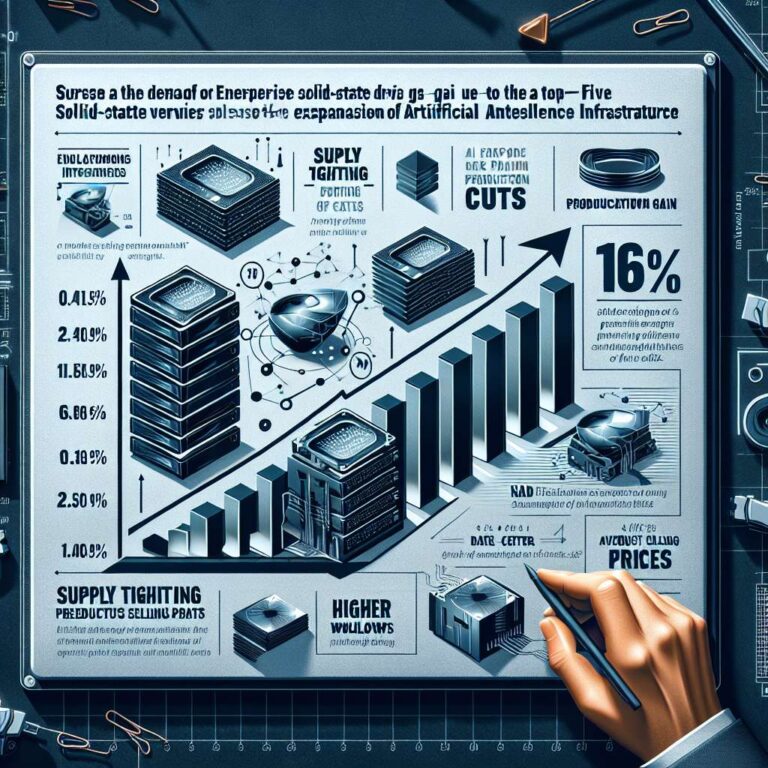
TrendForce reports that the expansion of Artificial Intelligence infrastructure by CSPs drove strong enterprise SSD demand in 3Q25, lifting the combined revenue of the top five NAND Flash vendors by 16.5% QoQ. TrendForce also forecasts continued demand for high-performance enterprise SSDs into 4Q25 amid rising NAND Flash prices.

TrendForce research shows that the ongoing expansion of Artificial Intelligence infrastructure by CSPs fueled strong demand for enterprise SSDs in 3Q25. The report states the combined revenue of the top five NAND Flash vendors grew by 16.5% QoQ, approaching US$17.1 billion. Earlier production cuts are starting to affect the market, helping to balance supply and demand in the latter half of the year, while a rising proportion of enterprise SSD shipments contributed to increased ASPs among suppliers.

Looking ahead to 4Q25, TrendForce forecasts that demand driven by Artificial Intelligence for high-performance TLC and QLC enterprise SSDs will continue to grow. The research cautions that as suppliers’ inventories normalize and node migrations generate typical yield-related losses, shipment growth will be more restrained. At the same time, ongoing shortages in HDD supply are expected to maintain upward pressure on NAND Flash prices, with TrendForce predicting total NAND Flash prices will rise by 20–25%, which would further boost quarterly revenue for vendors.

The analysis frames the current market as one of tightening supply and sustained demand for enterprise-class storage. Production cuts and inventory normalization are rebalancing supply and demand, while technology transitions and yield impacts may limit shipment growth despite strong orders for high-performance SSDs. Price increases driven in part by HDD shortages and a higher share of enterprise SSDs in shipments point to improved ASPs and revenue upside for NAND Flash suppliers in the near term.
55

Impact Score

Europe’s Artificial Intelligence challenge is structural dependence

Europe has talent, research strength, and rising investment in Artificial Intelligence, but startups remain reliant on American infrastructure, platforms, and late-stage capital. The argument centers on digital sovereignty, interoperability, and ownership as the conditions for building durable European champions.

Community backlash slows Artificial Intelligence data center expansion

Political resistance, regulatory scrutiny, and rising energy and water concerns are complicating the build-out of large Artificial Intelligence data centers across the United States. The pressure is increasing costs, delaying projects, and adding fresh risks to the economics behind Generative Artificial Intelligence infrastructure.

House panel advances export controls after China report

The House Foreign Affairs Committee moved export control legislation after a House Select Committee report detailed China’s use of illegal means to build its Artificial Intelligence and semiconductor sectors. The measure is aimed at chip smuggling and Artificial Intelligence model theft.

Intel repurposes scrap dies to expand CPU supply

Intel is repurposing wafer-edge and lower-yield silicon that would normally be discarded into sellable CPUs as industry demand outpaces supply. The strategy reflects a market where customers are willing to buy lower-tier parts to secure any available capacity.

Contact Us

Got questions? Use the form to contact us.

Contact Form

Clicking next sends a verification code to your email. After verifying, you can enter your message.