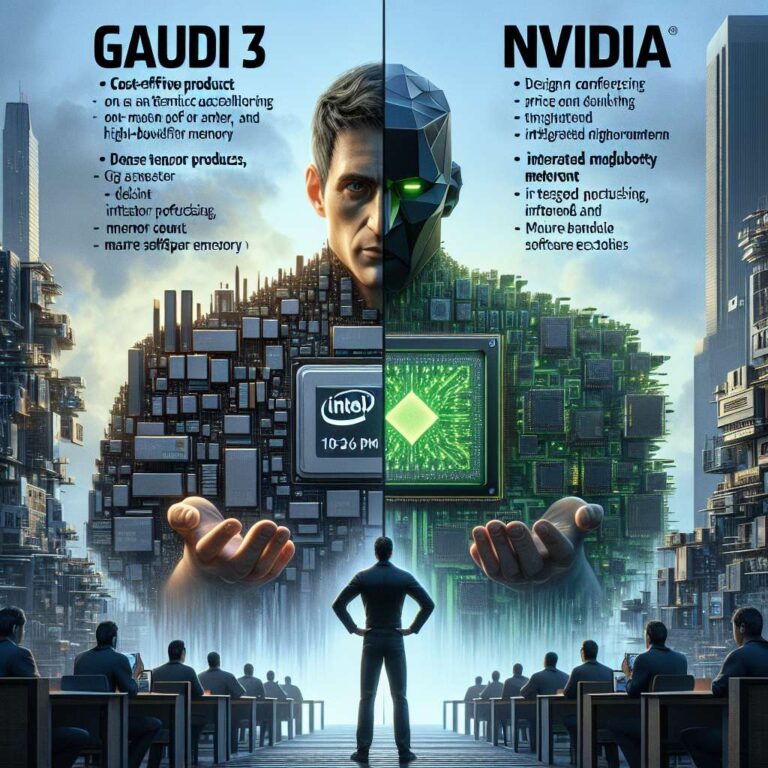
Intel and NVIDIA are locked in a high-stakes contest over artificial intelligence compute as of November 2025. The article frames the rivalry as more than a market skirmish: it is driving innovation, changing procurement strategies and influencing software ecosystems. Intel markets Gaudi 3 as a purpose-built, cost-effective Artificial Intelligence accelerator aimed at broad enterprise adoption, while NVIDIA continues to push raw performance with its H100 and H200 GPUs and the new Blackwell B200 family.
Technically the two approaches diverge. Intel’s Gaudi 3 is built on a 5nm process with 64 tensor processor cores and eight matrix multiplication engines, 128GB of HBM2e memory at 3.7 TB/s, 96MB on-board SRAM, and integrated networking with twenty-four 200Gb Ethernet ports. Intel claims 1.8 petaFLOPS for BF16 and FP8, up to 40% faster general acceleration than the H100, up to 1.7 times faster training for Llama 2-13B, and better inference power efficiency of up to 2.3 times versus NVIDIA parts. NVIDIA’s H-series remains focused on transistor and interconnect scale: the H100 uses the Hopper architecture and TSMC 4N process with 80 billion transistors, up to 3,341 TFLOPS (FP8) and 80GB HBM3 at 3.35 TB/s with NVLink. The H200 increases memory to 141GB HBM3e at 4.8 TB/s. Blackwell B200 is described with 208 billion transistors, new low-precision formats (FP4/FP6), an integrated decompression engine and fifth-generation NVLink delivering up to 10 TB/s, with claimed large gains in training performance and inference efficiency.
The market impact is significant. NVIDIA holds an estimated 94% share of the AI GPU market, while Intel projects capturing about 8 to 9% of AI training in select enterprise segments. The competition benefits end users, hyperscalers and startups by expanding hardware choices and pressuring price-performance and energy efficiency. Key dynamics to monitor include real-world benchmarks of Blackwell versus Gaudi 3, enterprise and cloud adoption of Intel’s open ecosystem and oneAPI versus NVIDIA’s CUDA, the ramp of custom chips by hyperscalers, supply-demand imbalances, energy consumption concerns for frontier models and geopolitical export controls shaping global chip supply chains.