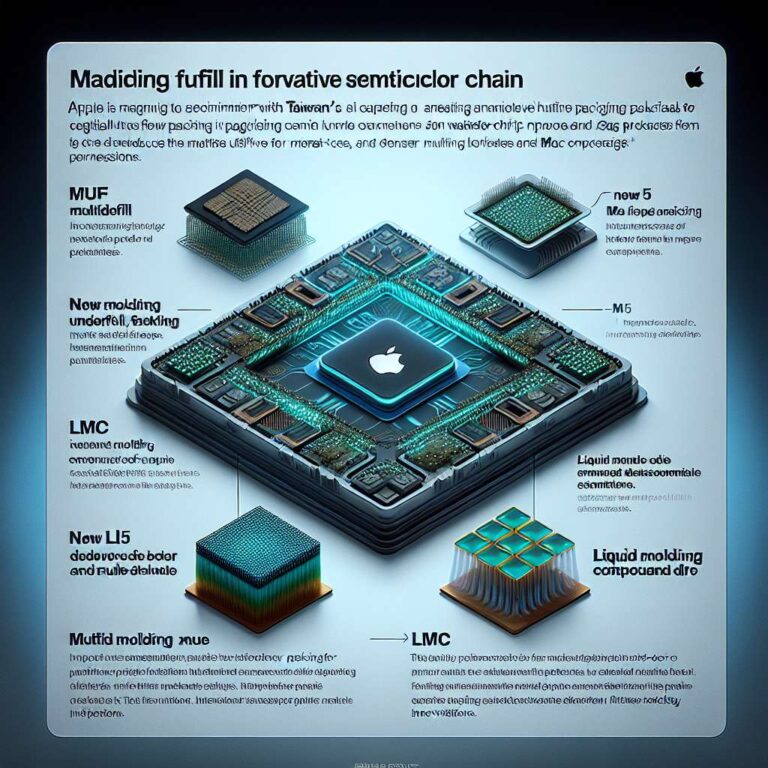
Ming-Chi Kuo reports that Apple has reworked part of its semiconductor supply chain by awarding Taiwan´s Eternal Materials exclusive roles supplying critical packaging compounds for its 2026 iPhone and Mac chips. Eternal will provide molding underfill, known as MUF, for the A20 iPhone packages and a liquid molding compound, or LMC, for the high-end M5 Mac processors. TSMC has completed qualification of the materials and validation for use with chip-on-wafer-on-substrate packaging, known as CoWoS, is underway. Initial shipments could begin in 2026 with a larger role for Eternal forecast for 2027 and 2028.
The iPhone change moves Apple from integrated fan-out packaging to wafer-level multi-chip module processes that use MUF. That transition combines underfill and molding into a single wafer-level step. The result should reduce material consumption, simplify assembly and lower costs. Apple and its partners expect yields to improve because one combined step removes handling and alignment steps that can introduce defects. This is a material and process shift that also signals a broader rethink of packaging choices across product lines.
For Macs, introducing a CoWoS-compatible LMC for M5 packages brings several manufacturing benefits. The compound provides better structural integrity and cleaner thermal paths, which can help with heat dissipation and mechanical stability in denser multi-die stacks. Apple is not moving to full CoWoS for the M5 generation, but this LMC adoption prepares the substrate and process ecosystem for future CoWoS and later chip-on-package scaling such as CoPoS. Eternal reportedly beat long-established japanese suppliers including Namics and Nagase to win the orders. The award could spur OSAT partners and other manufacturers to trial the compounds, and it places a taiwanese materials supplier into a space long dominated by japanese firms while aligning Apple and TSMC around packaging choices that enable higher memory bandwidth and denser compute layouts.