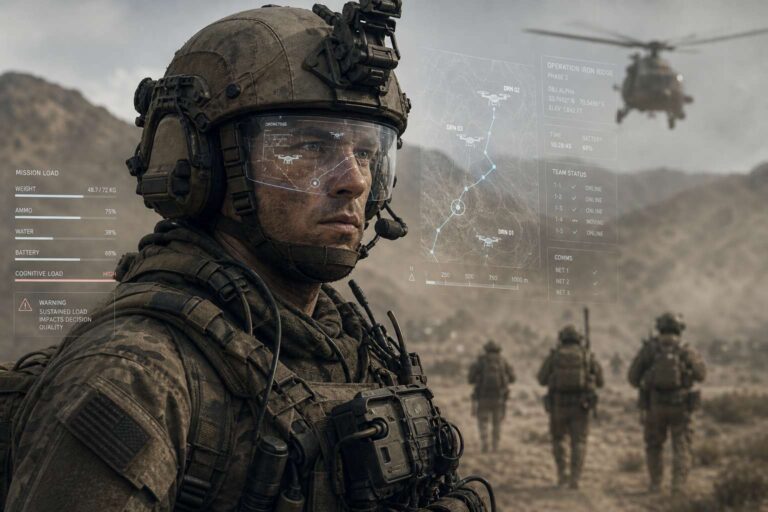
Anduril has shared a more detailed vision for augmented-reality headsets it is developing with Meta for military use. The company is pursuing two related efforts: the Army’s Soldier Born Mission Command program and a separate self-funded helmet and headset system called EagleEye. Quay Barnett, an Anduril vice president with a background in the Army’s Special Operations Command, describes the goal as linking soldiers, drones, and battlefield software more tightly so they can share information and act in concert. Both systems remain early-stage and are still years from any broad deployment.
The glasses are designed to place information directly into a soldier’s field of view, ranging from basic navigation cues to maps, drone locations, and Artificial Intelligence-driven target recognition. Soldiers would interact with the system in plain language to request actions such as evacuation or route planning, with large language models helping convert spoken requests into software commands. Anduril says it is testing Google’s Gemini, Meta’s Llama, and Anthropic’s Claude for that layer, while its Lattice software provides the common operating picture by pulling together data from military hardware. Barnett’s team is also designing the headset for multi-step workflows, such as dispatching a drone to search for an artillery unit and then recommending follow-on actions that would still require approval through the normal chain of command. In some cases, eye tracking and subtle taps could replace speech altogether.
The hardware is still immature. Barnett says the concepts have worked in early prototypes, but the company does not yet have versions ready for large-scale Army testing. The component parts began arriving in March, and federal contracting rules required new supply chains that avoid reliance on Chinese companies. Meta is building much of the hardware, including displays and waveguides, while Anduril is testing a new digital night vision system that uses electronic sensors and algorithms to enhance low light. The company says newer generative Artificial Intelligence techniques and older machine learning methods have improved results over earlier prototypes.
Operational concerns remain significant. Jonathan Wong of RAND, a former US Marine, argues that any headset must reduce cognitive burden rather than add to it, because soldiers already operate in overloaded information environments. A system that identifies threats and recommends strikes would also deepen frontline dependence on imperfect Artificial Intelligence, creating the risk of serious errors. The devices must survive dust, smoke, and explosions, run demanding computer vision and Artificial Intelligence models locally without dependable 5G connectivity, and avoid adding too much weight to soldiers already carrying upwards of 100 pounds. For the Army version, the technology will mount onto existing helmets and gear with a separate battery pack, while EagleEye integrates the system into the helmet itself. Barnett says Anduril may market EagleEye to foreign militaries even if the Army declines it.