
AMD´s next-gen UDNA: four die sizes, one potential 96-cu flagship

Leaked block diagrams attributed to hardware leaker Kepler_L2 outline a modular AMD UDNA graphics family spanning four die sizes and a possible 96 compute unit flagship, with detailed shader array, engine, and memory controller layouts.

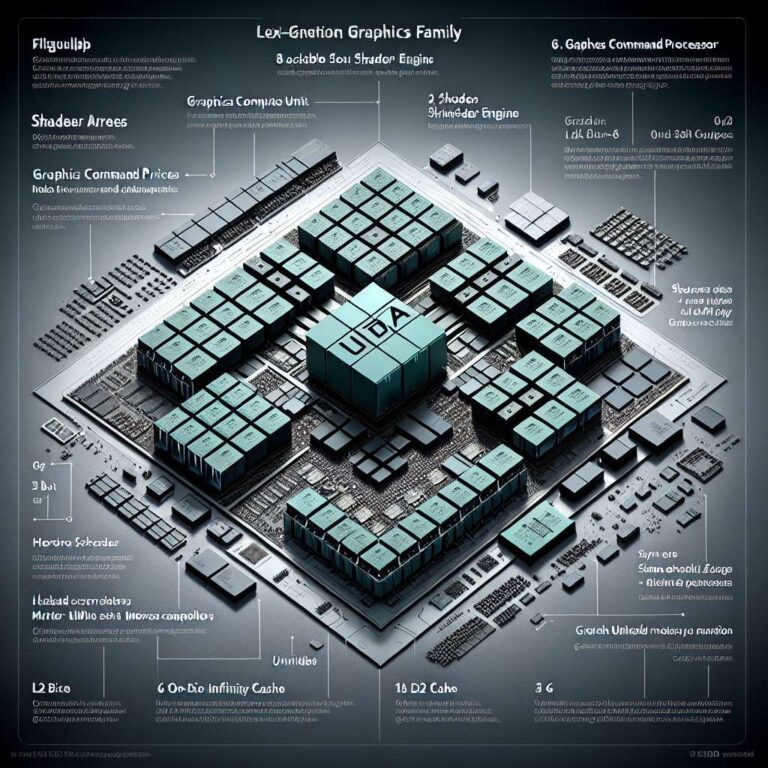
Leaked block diagrams from well-known hardware leaker Kepler_L2 sketch a modular next-generation AMD UDNA graphics family that could come in four die sizes, with the largest configuration rumored to top out at 96 compute units. The images depict repeating shader arrays and shader engines, with each engine containing multiple compute units and its own render backend. Those shader engines appear to feed into a central system-on-chip block that houses the graphics command processor, the graphics engine, hardware schedulers, and a shared L2 cache. On the memory side, the flagship diagram shows sixteen unified memory controllers, each listed as 32 bits wide, which would total a 512-bit external interface, and the leak also mentions a potentially much larger on-die Infinity Cache for the top-tier die.

Mapping the diagrams to specific configurations produces numbers consistent with the 96 compute unit claim. The flagship layout is described as eight shader arrays with two shader engines per array, yielding sixteen shader engines. At six compute units per engine, that configuration reaches the 96 compute unit figure. A mid-tier design reduces the scale to four shader arrays and eight shader engines with five compute units per engine, which works out to about 40 compute units and an estimated six memory controllers for a 192-bit memory bus. The leak further shows smaller designs with roughly 24 compute units and 12 compute units built from smaller arrays and fewer memory controllers.

One unusual detail is the 24 compute unit design being shown with as many as eight memory controllers, suggesting the controller widths could vary depending on whether the part uses a traditional gddr-style interface or an lpddr5x-like arrangement. Overall, the diagrams emphasize a highly modular architecture that can scale shader arrays, shader engines, compute unit counts, and memory controller counts across multiple die sizes. The details come from a rumor and leaked diagrams and should be treated as unconfirmed until AMD provides official specifications.
62

Impact Score

Indiana launches Artificial Intelligence business portal

Indiana is rolling out IN AI, a statewide portal meant to help employers adopt Artificial Intelligence with practical guidance, workshops and peer support. State leaders and business groups are positioning the effort as a way to raise productivity, wages and job growth while keeping workers at the center.

Goodfire launches model debugging tool for large language models

Goodfire has introduced Silico, a mechanistic interpretability platform designed to let developers inspect and adjust model behavior during development. The company is positioning it as a way to give smaller teams deeper control over open-source models and more trustworthy outputs.

Nvidia launches nemotron 3 nano omni for enterprise agents

Nvidia has introduced Nemotron 3 Nano Omni, a multimodal open model designed to support enterprise agents that reason across vision, speech and language. The launch extends Nvidia’s push beyond hardware into models and services while targeting more efficient agentic workflows.

Intel 18A-P node improves performance and efficiency

Intel plans to present new results for its 18A-P process at the VLSI 2026 Symposium, highlighting gains in performance, power efficiency, and manufacturing predictability. The updated node is positioned as a stronger option for customers seeking 18A density with better operating characteristics.

EA CEO defends broader Artificial Intelligence use in game development

EA CEO Andrew Wilson defended the company’s internal use of Artificial Intelligence after employee claims that the tools were slowing work rather than helping. He framed the technology as an aid for repetitive quality assurance tasks, even as concerns persist over its broader impact on development.

Contact Us

Got questions? Use the form to contact us.

Contact Form

Clicking next sends a verification code to your email. After verifying, you can enter your message.