
Ambersemi tapes out Powertile vertical power solution for artificial intelligence data centers

Amber Semiconductor has completed silicon tape out for its Powertile vertical power delivery device, designed to feed artificial intelligence processors in data centers from directly beneath the package. The company claims the approach sharply cuts distribution losses and removes a key bottleneck in scaling processor power.

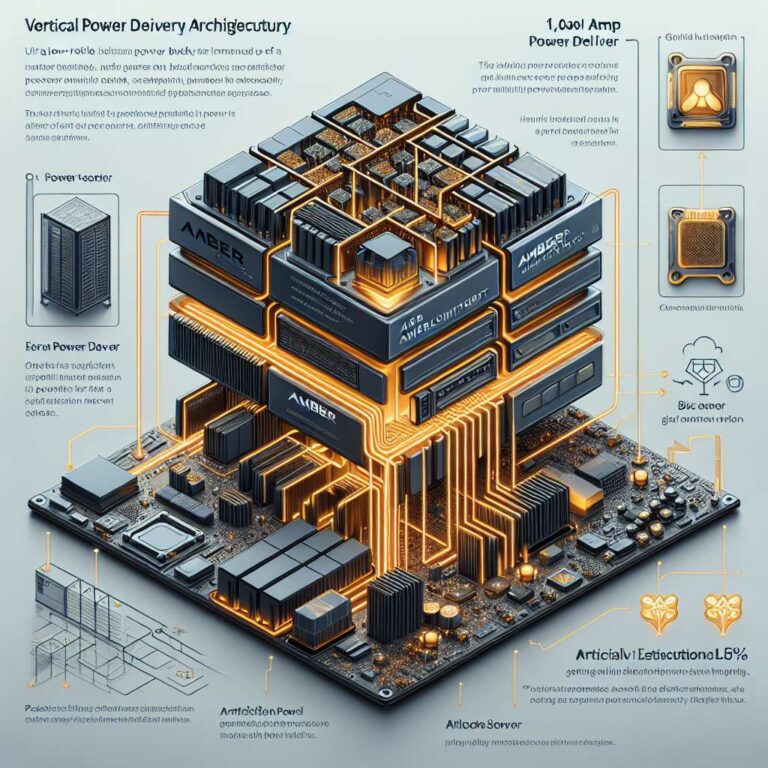
Amber Semiconductor, Inc., a fabless semiconductor company focused on next generation power management for data centers, has announced the successful tape out of its AmbersSemi Powertile vertical power delivery solution built specifically for artificial intelligence processors in data centers. The company positions Powertile as a new approach to feeding increasingly power hungry accelerators, with the device installed on the backside of a server board directly under the processor package rather than at the board periphery.

The ultra low profile Powertile is described as a 1,000 Amp vertical power device that can be mounted on the backside of a server board, directly beneath the processor. By pushing current through a short vertical path instead of across the board in a traditional lateral distribution layout, AmbersSemi states that Powertile reduces power distribution losses to the processor by more than 85%, which is intended to improve overall efficiency and make it easier to scale power delivery as artificial intelligence workloads grow.

Chief executive officer Thar Casey says the product represents a paradigm change in how power is distributed and delivered to artificial intelligence processors in data centers, arguing that existing architectures are struggling to keep up with the rising demands of next generation chips and are creating a performance limiting bottleneck. According to Casey, Powertile is designed to deliver extremely high current in a compact form factor that mounts directly beneath the processor for a shorter and more efficient power path, and the completion of this tape out is described as a critical inflection point as the company moves toward commercialization.
52

Impact Score

Microsoft launches Copilot Health in the US

Microsoft has introduced Copilot Health as a protected space inside Copilot that combines medical records, wearable data and lab results into personalised health insights. The service is launching first for adults in the US with strong privacy controls and a limited initial rollout.

Tesla plans terafab for Artificial Intelligence chips

Tesla is moving toward a large-scale chip manufacturing project to support its autonomous driving roadmap. Elon Musk said the terafab effort for Artificial Intelligence chips will launch in seven days and may involve Intel, TSMC and Samsung.

Timeline traces evolution, civilisation and planetary stewardship

A sweeping chronology links cosmology, evolution, human history and modern environmental risk in a single long view of the human condition. The sequence culminates in contemporary debates over climate change, biodiversity loss and artificial intelligence governance.

Wolters Kluwer report tracks Artificial Intelligence shift in legal work

Wolters Kluwer’s 2026 Future Ready Lawyer findings show Artificial Intelligence has become a foundational tool across law firms and corporate legal departments. The survey points to measurable time savings, revenue growth, and rising pressure to strengthen training, ethics, and security.

Anthropic March 2026 release roundup

Anthropic rolled out a broad set of March 2026 updates across Claude Code, the Claude Developer Platform, Claude apps, and enterprise partnerships. Changes focused on larger context windows, workflow improvements, reliability fixes, visual output features, and new partner enablement programs.

Contact Us

Got questions? Use the form to contact us.

Contact Form

Clicking next sends a verification code to your email. After verifying, you can enter your message.